Canadian Construction Market Outlook 2026: Investment Is Rising While Housing Starts Fall
Investment in Canadian building construction reached $155.6 billion over the first seven months of 2026, up 6.1% on the same period in 2025 and 12.2% on 2024.
Across the full year 2025 the figure was $263.7 billion, up 5.3% on 2024. The category is growing and accelerating. It is also growing while new housing starts fall, which tells you something about where the money is going.

July 2026 at $26.2 billion is the highest month in the period and March 2024 at $18.0 billion the lowest. The series has a mild seasonal shape, with the first quarter weakest and the June to September stretch strongest.
Every Month of 2026 Beat the Year Before
All seven published months of 2026 came in above the same month of 2025, ranging from 3.2% in February to 8.3% in July.


Growth is also running ahead of last year's pace. The same seven months of 2025 were 5.7% ahead of 2024. In 2026 the gap is 6.1%, and the three most recent months have been the strongest of the year.
Residential Is 68.5% of Construction Investment and Growing Faster
Residential construction accounted for $106.6 billion of the $155.6 billion invested, up 6.8%. Non-residential accounted for $49.0 billion, up 4.7%.
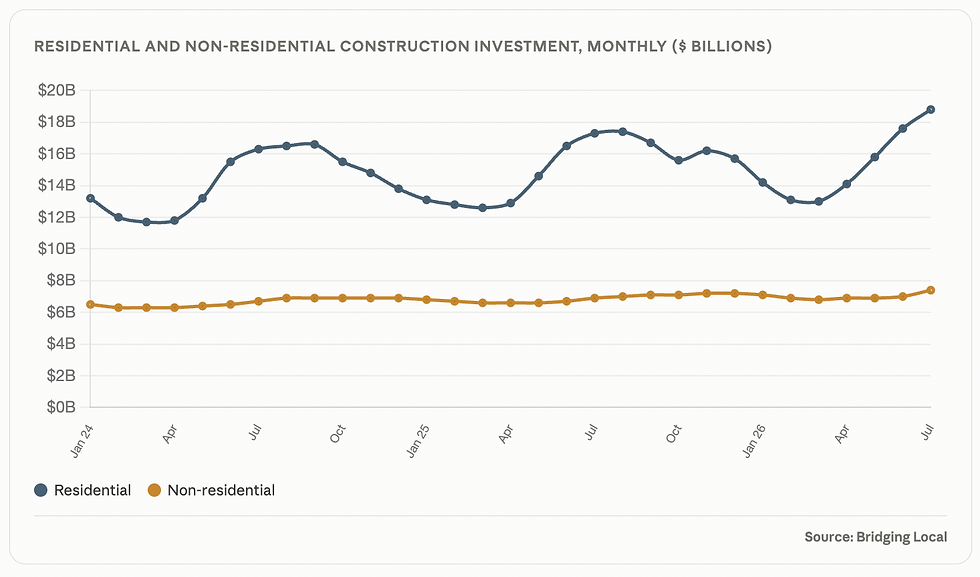

Residential has gained share in each year, from 67.6% over the first seven months of 2024 to 68.5% in 2026. Within non-residential, commercial is the largest component at $24.3 billion and 15.6% of all construction investment, followed by institutional and government at $15.0 billion and industrial at $9.8 billion.
Single Dwellings Are Outgrowing Apartments on Spending
Investment in single dwelling buildings reached $48.6 billion over the first seven months of 2026, up 9.4%. Multiple dwelling buildings reached $58.0 billion, up 4.7%. Apartments specifically grew 4.4%.


This runs in the opposite direction to the housing starts data, where single-detached starts fell 6.5% and apartments fell 3.1%. Spending on single dwellings is rising while fewer of them break ground.
The explanation is renovation. This series covers all types of work, including renovation and conversion, not only new construction. Single dwelling investment growing 9.4% while single-detached starts decline is consistent with money moving into existing homes rather than new ones. For a builder, that distinction decides whether the opportunity is in new subdivisions or in the renovation market, and the two require different businesses.
On a two-year view the picture is different again. Multiple dwellings are up 15.7% against 2024 and singles 11.6%, so apartment-led growth still dominates the longer comparison.
Industrial Construction Has Stalled
Industrial construction investment reached $9.8 billion over the first seven months of 2026, up 0.9% on 2025 and 1.0% on 2024. It is the weakest of the three non-residential sectors on both comparisons.
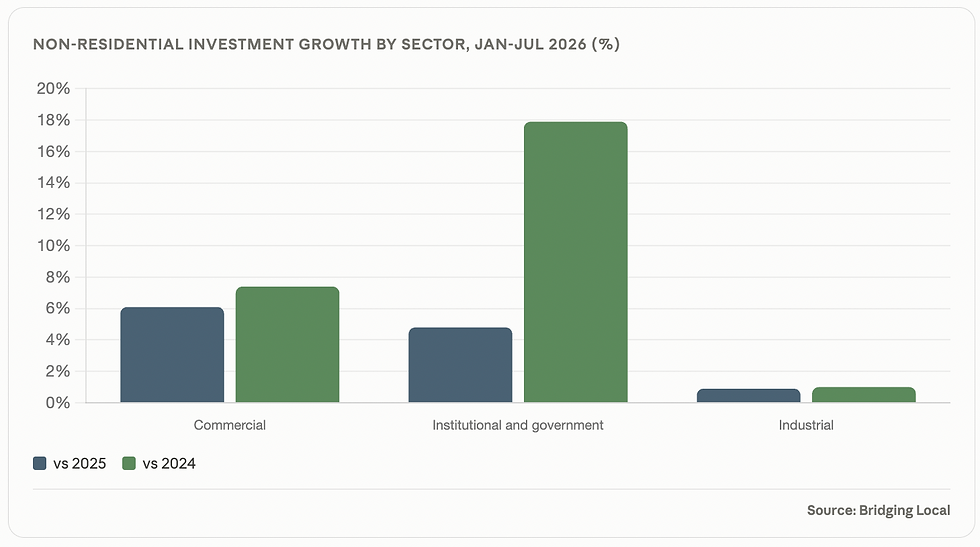
Across the full year 2025 industrial construction fell 2.6% to $16.6 billion, the only non-residential sector to decline that year. Commercial grew 2.0% and institutional and government grew 10.9%.
The weakness sits in factories. Investment in factories and plants fell 11.5% over the first seven months of 2026 to $4.0 billion, and is 13.7% below its 2024 level. Mining and agriculture buildings are 14.6% below 2024.
Factory investment is the one line clearly going backwards. Down 11.5% this year and 13.7% over two years, in a market growing 12.2% over the same two years. Whatever is driving the national construction expansion, new manufacturing capacity is not part of it.
Care Homes, Transit and Labs Are Growing Fastest
Three building types grew by more than 19% over the first seven months of 2026, and three declined.


Welfare and care home construction has grown 56.6% in two years and transportation and utilities buildings 53.8%, the two largest two-year gains in the data. Office buildings, widely assumed to be in retreat, are up 15.3% against 2024.
Government buildings fell 14.2% this year and are 12.8% below 2024, the second steepest two-year decline after factories.
Where percentage growth and dollars diverge. Laboratories grew fastest at 28.2% and represent $0.3 billion. Apartments grew 4.4% and represent $48.3 billion. For a contractor choosing which market to chase, the laboratory figure describes a niche and the apartment figure describes the industry.
Ontario Is 36.3% of the Market and Shrinking
Ontario accounted for $56.4 billion of construction investment over the first seven months of 2026, 36.3% of the national total. It fell 2.0% on 2025.


The national gain is coming from everywhere except the largest market. Quebec added $5.6 billion, Manitoba $1.8 billion and British Columbia $2.1 billion, while Ontario lost $1.2 billion.

Quebec has grown 26.9% in two years against Ontario's 2.9%, narrowing the gap between them from $26.6 billion over the first seven months of 2024 to $20.7 billion in 2026. Manitoba is up 50.4% in two years, the largest gain of any province.
Market Projections
Applying the January to July growth rate of 6.1% to the remainder of the year gives full-year 2026 investment of $279.8 billion, an increase of $16.1 billion on 2025.


That would be the third consecutive year of growth and the largest single-year increase in the period, against $13.4 billion added in 2025. Residential would reach $193.7 billion and industrial would remain below its 2024 level.

What we do at Bridging Local
We run custom research for businesses that need answers national datasets cannot provide. That means local market and pipeline analysis, competitor research, and more!
For contractors, suppliers, developers and investors, that usually looks like sizing the addressable pipeline in a defined area, understanding competitive pricing and win rates, testing a new service or product with the people who buy it, or building the evidence a lender or board will ask for.
If you are planning, bidding or investing in construction and need evidence rather than inference, that is the work we do. Custom surveys, in-depth interviews, competitive analysis and regional pipeline research, built around your specific decision.
Frequently Asked Questions
How big is the Canadian construction market in 2026?
Investment in Canadian building construction reached $155.6 billion over the first seven months of 2026, up 6.1% on the same period in 2025. On that run rate the full year would reach $279.8 billion, against $263.7 billion in 2025 and $250.3 billion in 2024. These figures cover building construction only and exclude engineering work such as roads and pipelines.
Is construction investment growing in Canada?
Yes, and slightly faster than last year. Investment grew 5.3% across 2025 and is running 6.1% ahead through the first seven months of 2026. All seven published months came in above the same month of 2025, from 3.2% in February to 8.3% in July. July 2026 at $26.2 billion is the highest month in the period.
Why is construction investment rising while housing starts are falling?
Because they measure different things. Housing starts count dwellings where construction began. Investment captures money spent across all types of work, including on projects already underway and on renovation and conversion of existing buildings. Investment in single dwelling buildings grew 9.4% over the first seven months of 2026 while single-detached housing starts fell 6.5%, a pattern consistent with spending moving into existing homes rather than new ones.
How much of Canadian construction is residential?
68.5% over the first seven months of 2026, worth $106.6 billion of $155.6 billion. Non-residential accounts for the remaining 31.5%, split between commercial at $24.3 billion, institutional and government at $15.0 billion and industrial at $9.8 billion. Residential has gained share in each year, from 67.6% in 2024.
Which construction sectors are declining in Canada?
Three building types fell over the first seven months of 2026: government buildings at 14.2%, factories and plants at 11.5%, and schools and education at 2.2%. Factories and government buildings are also below their 2024 levels, by 13.7% and 12.8%. Industrial construction overall grew just 0.9% and fell 2.6% across 2025, the only non-residential sector to decline that year.
Which province leads Canadian construction investment?
Ontario, at $56.4 billion over the first seven months of 2026 and 36.3% of the national total, followed by Quebec at $35.8 billion and British Columbia at $25.2 billion. Ontario is the only large province contracting, down 2.0%. Manitoba grew fastest at 41.9%, followed by Saskatchewan at 19.4% and Quebec at 18.5%. Newfoundland and Labrador fell 21.4%.
About This Analysis
This analysis was produced by Bridging Local (RC Research & Insights Inc.), a Vancouver-based market research and business consulting firm. We run primary research across B2B and B2C markets, including surveys, in-depth interviews, competitive analysis, local market deep dives and go-to-market strategy.
If you are sizing a market, testing a concept, or working out where demand sits in your category, our market research services are built for exactly that.