Canadian Apparel Retail Market 2026: A $40 Billion Category Growing at Half Last Year's Rate

Canadians spent $39.9 billion on clothing in 2025, up 8.5%. Through the first seven months of 2026 growth has fallen to 4.3%. Women's apparel is the only segment holding above the market rate.


This is the most seasonal retail category in the Canadian data. January 2024 at $2.1 billion is the lowest month in the period and December 2025 at $4.8 billion the highest, a range of $2.7 billion between the quietest and busiest month.
Growth Has Fallen From 9.4% to 4.3%
Comparing the same seven months across three years shows the slowdown clearly. The first seven months of 2025 were 9.4% ahead of 2024. The first seven months of 2026 are 4.3% ahead of 2025.


Every month of 2026 is ahead of the same month in 2025, but the pattern is uneven. March at 1.3% is the weakest comparison in the period and June at 7.9% the strongest, with no consistent direction between them.
Women's Apparel Is 56.9% of the Market and the Only Segment Above Rate
Women's clothing generated $12.2 billion over the first seven months of 2026, up 5.0%. Men's generated $6.9 billion, up 3.9%. Children's and infant generated $2.1 billion, up 3.2%.

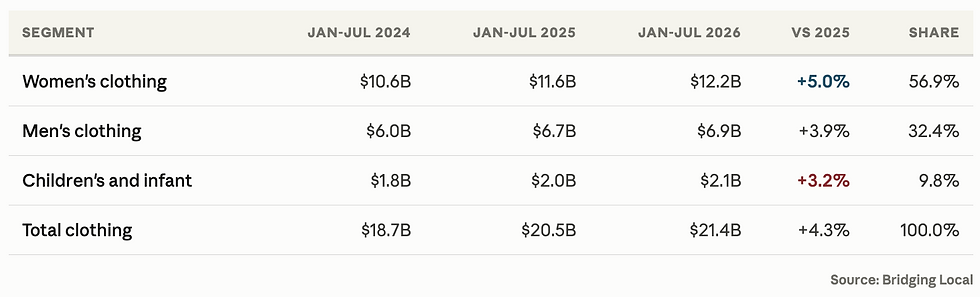
The segment shares have barely moved in two years. Women's held 56.7% of the market over the first seven months of 2024 and holds 56.9% now. Men's moved from 32.3% to 32.4% and children's from 9.9% to 9.8%.
Against 2024, all three segments are within a percentage point of each other at 14.5%, 14.5% and 13.6%. The divergence is recent and sits entirely in the 2026 numbers.
Accessories Are Growing Fastest, Basics Are Adding the Most Dollars
Men's hats, gloves, belts and other accessories grew 11.9% over the first seven months of 2026, the fastest of any subcategory with publishable data. Women's handbags and accessories grew 8.6% and women's lingerie and sleepwear 8.0%.

Ranked by dollars rather than percentage, the list reorders completely. Women's skirts, pants and blouses added $210.1 million on 3.4% growth. Men's pants, shirts and sweaters added $205.4 million on 5.5%. Men's accessories, the fastest growing line in the category, added $66.5 million.
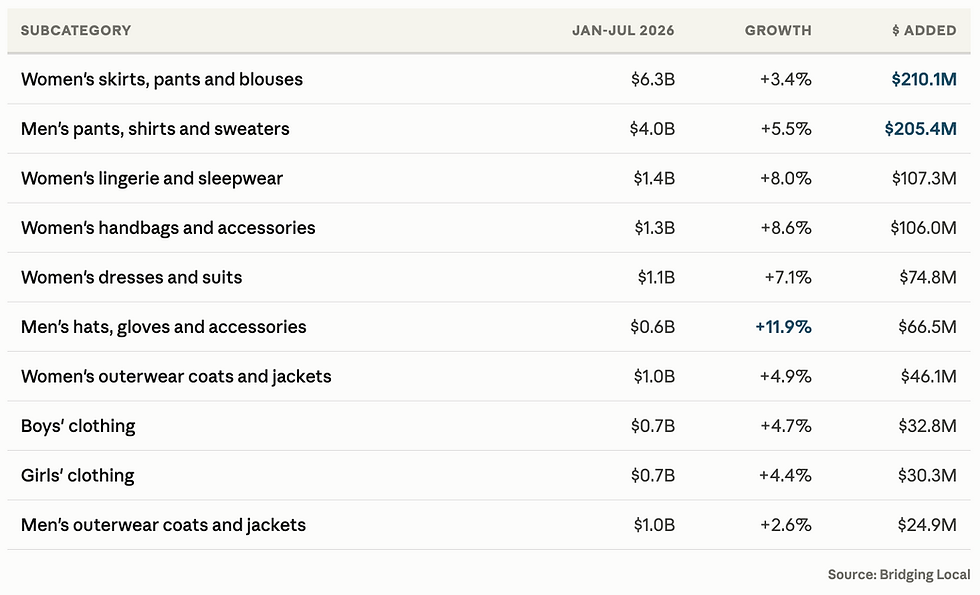
The two largest subcategories, women's and men's tops and bottoms, are together $10.3 billion and 48.2% of all clothing sales. Both are growing at or below the category rate, which is the mechanical reason the market has slowed.
Where the category is actually won. Everyday tops and bottoms are nearly half the market and are growing slowest. Accessories, handbags and lingerie are growing fastest from bases a fraction of the size
Three Categories Are Shrinking
Three subcategories recorded lower sales over the first seven months of 2026 than over the same period in 2025.

Men's sleepwear and underwear fell 5.2% to $514.8 million, a loss of $28.2 million. Women's hosiery fell 2.0% to $293.1 million. Men's clothing not elsewhere classified fell 1.6% to $374.4 million.
Men's sleepwear is the only one of the three that is also below its 2024 level on a two-year view, at 2.2% above. Women's hosiery remains 5.7% above 2024 despite the decline this year.
Infant clothing was effectively flat at 0.3% growth, adding $2.2 million. It is the weakest performer among categories still growing.
December Sells Twice What February Does
December 2025 recorded $4.8 billion in clothing sales. February 2026 recorded $2.4 billion. The ratio is 2.0 to 1.

December ran 44.2% above the 2025 monthly average and 49.9% above the 2024 average. November is the second strongest month in both years. The two months together account for roughly 22.7% of annual clothing sales.
Outerwear is the most extreme line in the data. Women's coats and jackets sold $356.6 million in December 2025 and $105.7 million in June 2026, a ratio of 3.4 to 1. Men's coats and jackets ran 2.5 to 1 between December 2025 and July 2026.
What this concentration does to a clothing business. A category where two months carry nearly a quarter of annual sales, and where the top-to-bottom monthly swing is $2.7 billion, puts most of the year's margin and most of the year's markdown risk into the same eight-week window.
Where 2026 Finishes on Current Run Rate
Applying the January to July growth rate of 4.3% to the remainder of the year gives full-year 2026 clothing sales of $41.7 billion.


That would add $1.7 billion to the category in a single year, against $3.1 billion added in 2025. The increment is roughly half of last year's.

What we do at Bridging Local
We run custom research for businesses that need answers national datasets cannot provide. That means local market deep dives, competitor and pricing audits, surveys and interviews with the shoppers you are trying to reach, location assessment, and market sizing built from the ground up for a specific trade area rather than scaled down from national totals.
For retailers, brands, wholesalers and investors, that usually looks like testing a range or price point before a buy, sizing demand in a specific catchment, understanding what competitors offer and charge through the season, or building the revenue case a lender will ask for.
If you are opening, buying or expanding an apparel business and need evidence rather than inference, that is the work we do. Custom surveys, in-depth interviews, competitive analysis and local market deep dives, built around your specific decision.
Frequently Asked Questions
How big is the Canadian apparel retail market in 2026?
Canadians spent $21.4 billion on clothing in the first seven months of 2026, up 4.3% on the same period in 2025. On that run rate the full year would reach $41.7 billion. Clothing retail sales were $39.9 billion in 2025 and $36.8 billion in 2024. These are consumer retail sales in current dollars.
Is clothing retail growing in Canada?
Yes, but much more slowly than last year. Sales grew 8.5% across 2025 and are running 4.3% ahead through the first seven months of 2026, less than half the 9.4% pace recorded over the same months of 2025. Every month of 2026 is ahead of the same month in 2025, ranging from 1.3% in March to 7.9% in June.
How is the Canadian clothing market split between men's and women's?
Women's clothing accounts for 56.9% of sales at $12.2 billion over the first seven months of 2026, men's for 32.4% at $6.9 billion, and children's and infant for 9.8% at $2.1 billion. Those shares have barely moved in two years. Women's is growing fastest in 2026 at 5.0%, against 3.9% for men's and 3.2% for children's.
Which clothing categories are growing fastest in Canada?
Men's hats, gloves and accessories at 11.9%, women's handbags and accessories at 8.6%, and women's lingerie and sleepwear at 8.0%. In dollar terms the ranking changes: women's skirts, pants and blouses added $210.1 million and men's pants, shirts and sweaters $205.4 million, while men's accessories added $66.5 million despite the higher growth rate.
Which clothing categories are declining in Canada?
Three subcategories fell over the first seven months of 2026. Men's sleepwear and underwear dropped 5.2% to $514.8 million, women's hosiery 2.0% to $293.1 million, and men's clothing not elsewhere classified 1.6% to $374.4 million. Infant clothing was effectively flat at 0.3% growth.
How seasonal is clothing retail in Canada?
Heavily. December 2025 sales of $4.8 billion were twice February 2026 sales of $2.4 billion, and December ran 44.2% above the 2025 monthly average. November and December together account for roughly 22.7% of annual sales. Outerwear is the most extreme line: women's coats and jackets sold $356.6 million in December 2025 against $105.7 million in June 2026.
About This Analysis
This analysis was produced by Bridging Local (RC Research & Insights Inc.), a Vancouver-based market research and business consulting firm. We run primary research across B2B and B2C markets, including surveys, in-depth interviews, competitive analysis, local market deep dives and go-to-market strategy.
If you are sizing a market, testing a concept, or working out where demand sits in your category, our market research services are built for exactly that.