Canada Pet Food Market 2026: Why a Can$7.3 Billion Industry Is Growing at Ten Times the Rate of the Pet Population

Canada has not had a sudden surge in dogs and cats. The combined population of both animals is growing at under 1% a year. Barely above flat.

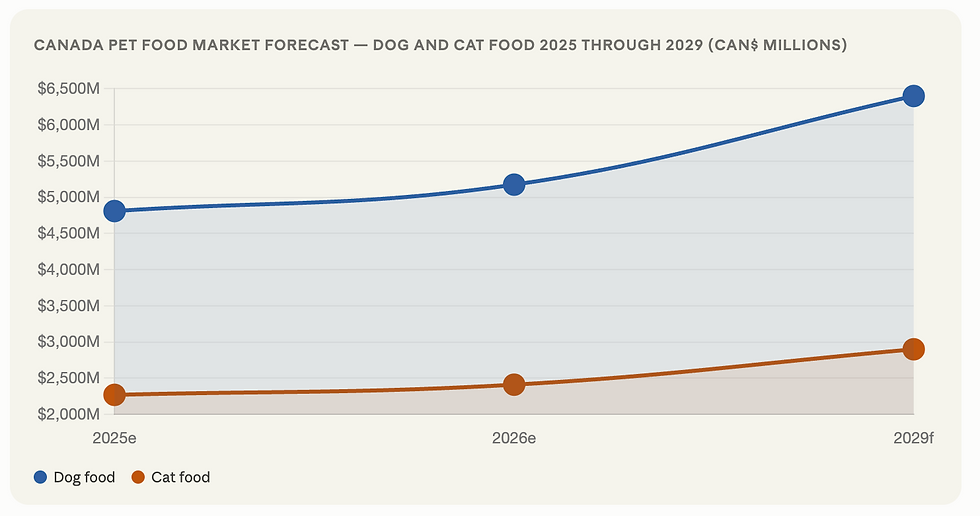
Yet the Canadian pet food market is estimated at Can$7.3 billion in 2025, up from Can$4.1 billion five years ago. It is heading to Can$7.9 billion by end of 2026 and Can$9.3 billion by 2029.

You do not build a pet food industry that grows at ten times the rate of the population it serves by adding more animals. You build it by convincing the owners of existing animals to spend more. A lot more. On things they did not used to buy.
That is the story of the Canada pet food market in 2025 and 2026. And it has real implications for every brand, retailer, and new entrant trying to figure out where the next phase of growth actually comes from.
The Number That Doesn't Add Up - Until You Understand What's Actually Driving It
Dog food in Canada is estimated at Can$4.81 billion in 2025. Cat food at Can$2.27 billion. Together they account for virtually every dollar of pet food retail spend in the country, fish, bird, and small mammal food are a rounding error by comparison at under 2% of the total market.

Now here is the number worth pausing on.
Canada's cat population is growing at 0.5% per year. Cat food revenue in Canada is growing at over 6%. That is a twelve-to-one ratio between revenue growth and population growth. No volume argument covers that gap. What covers it is price, specifically, the sustained, accelerating willingness of Canadian cat owners to pay significantly more per meal than they did the year before.
The Canadian dog food market tells a similar story. Premium dog food is expanding at nearly twice the rate of the dog population itself. The animals are not driving the market. The owners are.
Canada's Dog and Cat Population in 2025: 17.3 Million Animals and the Owners Behind Them
Canada has an estimated 8.4 million dogs and 8.9 million cats in 2025, spread across roughly 12.3 million pet-owning households. Nearly 38% of Canadian households own a dog. Just over 39% own a cat. For the pet food industry, those households, not the animals are the actual customers.
And those customers are not a monolith.
The fastest-growing segment of the Canadian dog population is small dogs. Not large dogs, which still make up 43% of the population and consume more food per animal than any other size category. Small dogs have grown at more than double the rate of large dogs over the past five years. They are concentrated in urban markets. Their owners skew younger. They spend more per kilogram of food than large dog owners, buy more frequently, and over-index in premium and fresh pet food formats.

The segment adding the most animals is also the segment spending the most money per animal. A new small dog owner in a Toronto or Vancouver condo in 2025 is not browsing the value aisle. She has opinions about protein sources before she sets foot in the store, and she found her preferred brand on Instagram before she found it on a shelf.
For cat owners in Canada, the spending shift is even more striking because it is happening without population growth to support it. Cat ownership has been essentially flat. The revenue growth in Canada's cat food market is coming almost entirely from existing cat owners upgrading what they buy, which means brands capturing that spend are not growing a new customer base. They are taking it from competitors.
The competitive implication: In a Canadian pet food market growing faster than its animal population, the fight is not for new customers. It is for the wallet share of owners who are already buying, and already looking for a reason to trade up. Brands that give them that reason consistently are winning. Brands waiting for population growth to do the work are losing ground quietly every quarter.
Canada Dog Food Market 2025-2026: Can$4.8 Billion and the Formats Reshaping the Category
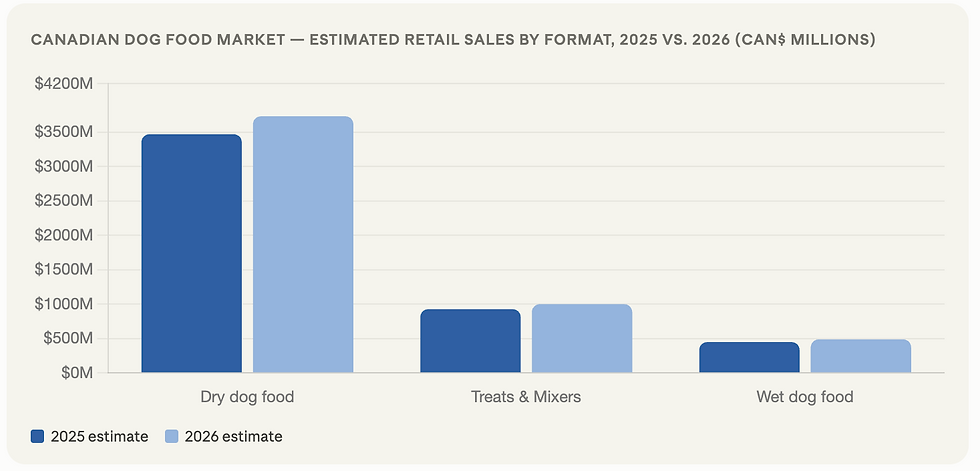
Dry dog food still commands about 72% of the Canadian dog food market. That is not changing dramatically in the near term. Kibble is convenient, affordable, and deeply habitual for millions of Canadian dog owners. It is also, increasingly, the format people feel most ambivalent about, which is exactly where market disruption starts.
Wet Dog Food in Canada: The Fastest-Growing Format
Wet dog food in Canada is estimated at Can$448 million in 2025, rising to Can$488 million in 2026, and it is growing faster than any other dog food format in the country. Premium wet is leading the charge. The old framing, wet food is for sick dogs or fussy eaters, is being replaced by a different narrative entirely: that wet food is simply what responsible, premium feeding looks like. Brands that spent years in the sick-dog and senior positioning are quietly repositioning around everyday nutrition. The ones moving fastest on that shift are gaining shelf space and online market share.
Raw dog food, freeze-dried, and dehydrated formats are accelerating alongside wet. Fresh meal delivery services, pre-portioned, ingredient-transparent, breed and life-stage specific have moved from novelty to a normal purchase channel for a growing segment of urban Canadian dog owners who are skeptical of anything that does not show them exactly what is in the bag.
Dog Treats in Canada: A Can$926 Million Line Item That Gets Underestimated
Dog treats and mixers in Canada sit at Can$926 million in 2025, approaching Can$1 billion in 2026. That makes the treats segment roughly the same size as the entire wet dog food category, yet it rarely anchors any serious strategic conversation about where the Canadian pet food market is heading.
The shift is not more treats. It is different treats. Functional dental chews with clinical backing. Training rewards with single-protein formulas. Freeze-dried toppers that transform a bowl of dry kibble into something the owner feels genuinely good about serving. The Canadian dog treat market has become the entry point for premiumization the place where owners first spend a little more and discover they like how it feels. From there, the jump to premium meals is a much shorter one.

Who is winning the Canadian dog food market right now: Nestlé Purina and Hill's have expanded their natural and grain-free Canadian lines to capture premiumization demand at scale. But direct-to-consumer entrants building around fresh delivery and ingredient transparency are establishing loyalty with younger urban owners that legacy distribution advantages cannot easily displace. The window for incumbents to close that trust gap is real but not unlimited.
Canada Cat Food Market 2025-2026: A Smaller Market With a Sharper Growth Trajectory
Canada's cat food market is estimated at Can$2.27 billion in 2025, rising to Can$2.41 billion in 2026. Smaller than the Canadian dog food market in dollar terms, but in terms of what is actually happening inside the category, this is the more surprising story in Canadian pet food right now.
Cats eat less than large dogs. There are marginally fewer cats than dogs in Canada by population. Cat ownership has barely grown in years. On paper this should be a stable, slow-moving segment of the Canadian pet food industry.
It is not. Revenue is running well ahead of every demographic input. The format split tells you exactly why.

Wet Cat Food Canada: Closing In on Dry
Wet cat food in Canada sits at Can$803 million in 2025, 35% of the category and climbing steadily. Dry cat food holds 53% and is losing ground slowly but with consistency. By 2029, the gap between the two formats will be meaningfully narrower than it is today.
Dry cat food is cheaper to produce, easier to store, and dominated the Canadian cat food market for decades on the strength of pure convenience. Wet is more expensive on every production measure. The fact that it is actively taking market share in a low-population-growth environment means Canadian cat owners are choosing to spend more, not because dry disappeared from shelves, but because the framing around feline nutrition has shifted and buyers are following it.
Premium wet cat food is forecast to be the fastest-growing tier in the entire Canadian cat food market through 2029. Canadian-sourced, high-meat-content, freeze-dried and raw cat food formats are not a specialty aisle story anymore. They are mainstream shelf in major Canadian pet retailers, and their growth trajectory suggests the ceiling is still some distance away.

Cat treats in Canada are a leading indicator. Cat treats and mixers, estimated at Can$268 million in 2025, posted the fastest growth of any segment in the Canadian cat food market last year. Treats are where owners experiment before committing to a premium meal transition. When treat spend rises, premium meal spend in that same owner cohort tends to follow within 12 to 18 months. The 2025 treat numbers are a preview of where cat food retail sales in Canada land in 2027.
Premium vs. Economy Pet Food in Canada: Why Both Are Growing and What That Really Means
Here is the part of the Canadian pet food market data that gets misread most consistently.
Economy pet food in Canada is not collapsing. Economy dry dog food is actually forecast to accelerate slightly through 2029. So a surface reading says: premiumization is overstated. Both ends are growing. No problem.
That reading is wrong.

Economy is growing because new pet owners enter the Canadian market at the accessible end. First-time dog owners do not typically start with fresh meal delivery. They start with the bag that looks reasonable at a price that feels manageable. That is the economy tier doing what entry points do.
But watch what happens next. The data on premium pet food growth in Canada, 9.3% for premium dry dog food versus 7.2% for economy, reflects that migration in progress. The economy tier gains new customers at the bottom while losing existing customers upward. Net it grows, but it grows as a funnel feeder, not as a destination.
Brands that own the economy end of the Canadian pet food market and have no credible premium offer are doing acquisition work for their competitors. They are bringing the customer in. Someone else is keeping them.
"Economy pet food in Canada grows at the entry point. Premium grows everywhere else. The mid-priced tier is being squeezed from both directions, and brands sitting there without a clear identity should be paying close attention."
The mid-priced squeeze: Mid-priced dry dog food in Canada is forecast to grow at 4.5%, below both premium and economy. Mid-priced is not a safe position in this market. It is where brands end up when they are not distinctive enough for premium buyers and not cheap enough to win on price. The Canadian pet food market is bifurcating. Picking a lane now matters more than it did five years ago.
Canadian Pet Food Market Forecast to 2029: Who Captures the Next Can$1.4 Billion
The Canadian dog food market reaches Can$6.4 billion by 2029. Cat food reaches Can$2.9 billion. Together the Canadian pet food industry approaches Can$9.3 billion roughly Can$1.4 billion more than 2026's estimated total.
That Can$1.4 billion does not distribute evenly across the market. It concentrates. It goes to premium wet formats, fresh and raw pet food, functional treats with ingredient transparency, and brands that can answer "where did this come from" and "why is this better for my specific animal" with something more convincing than a packaging redesign.
The incumbents are not standing still. Legacy players have the distribution to move volume at scale and the budgets to respond when a challenger gains traction. But distribution is not the same as trust, and the Canadian pet owners spending the most per animal are increasingly making decisions based on something large brands have historically struggled to manufacture at speed: authenticity.
New entrants building around fresh delivery, direct-to-consumer relationships, and breed or life-stage specificity are already capturing the highest-value customers in Canada's urban markets. The question is whether they can build the operational infrastructure to scale before a major incumbent floods the premium end with marketing budget.
That race will be decided in the next 24 to 36 months. Can$9.3 billion is the destination. Who reaches the premium end of it first is still genuinely open.
Frequently Asked Questions: Canada Pet Food Market 2026
How big is the Canadian pet food market in 2026?
Canada's dog and cat food market is estimated at approximately Can$7.9 billion in 2026. Dog food accounts for roughly 66% of that total at an estimated Can$5.17 billion, with cat food at approximately Can$2.41 billion. The broader Canadian pet food market, including fish, bird, and small mammal food, brings the total retail figure to approximately Can$8.1 billion.
What is driving growth in the Canadian pet food industry in 2026?
The primary driver is not population growth, Canada's combined cat and dog population is growing at under 1% annually. Growth in 2026 is being driven by premiumization: Canadian pet owners are spending significantly more per animal, upgrading from economy and mid-priced formats to premium wet, raw, freeze-dried, and fresh meal options. Pet humanization, ingredient label awareness, and the influence of veterinary and social media content are all accelerating this shift.
Which pet food format is growing fastest in Canada in 2026?
Premium wet food, in both dog and cat categories is the fastest-growing format in the Canadian pet food market heading into 2026. Premium wet dog food is forecast to grow at approximately 10.3% annually through 2029, with premium wet cat food close behind at 8.8%. Raw, freeze-dried, and fresh meal delivery formats are also expanding rapidly, particularly in urban Canadian markets. Dog treats and mixers are approaching Can$1 billion in annual retail sales and represent a significant secondary growth story.
What is the Canadian pet food market forecast through 2029?
The Canadian dog food market is forecast to reach Can$6.4 billion by 2029. Cat food is forecast to reach Can$2.9 billion. Together, Canada's dog and cat food market is projected to approach Can$9.3 billion, nearly double its size from a decade earlier. Premium wet formats in both categories are forecast to be the largest contributors to that incremental growth.
How many dogs and cats are there in Canada in 2026?
Canada is estimated to have approximately 8.4 million dogs and 9.0 million cats in 2026, totalling roughly 17.4 million animals across approximately 12.3 million pet-owning households. Large dogs remain the most common size category at 43.5% of the dog population, though the small dog segment has been the fastest-growing size category over the past five years, driven largely by urbanization and younger demographics entering pet ownership.
Is premium pet food actually outgrowing economy in Canada?
Yes, and by a significant margin. Premium dry dog food in Canada is forecast to grow at 9.3% through 2029, versus 7.2% for economy dry. In wet food the gap is wider still: premium wet is forecast at 10.3% versus 4.0% for economy wet. Both tiers are growing, but premium is growing at roughly double the rate. The economy tier functions primarily as a market entry point, new pet owners start there and migrate upward. The brands capturing that migration are the ones winning the Canadian pet food market in 2026.
What is happening to mid-priced pet food in Canada?
Mid-priced pet food is the most pressured tier in the Canadian market right now. Mid-priced dry dog food is forecast to grow at just 4.5% through 2029, below both premium and economy. The category is being squeezed from above by premium buyers trading up and from below by economy formats that compete purely on price. For brands sitting in the mid-priced tier without a clear point of differentiation, the 2026 market is a difficult place to be.
Need deeper insight into Canada's pet food market?
Bridging Local designs custom primary research, consumer surveys, category deep-dives, and competitive landscape studies, for brands and organizations navigating the Canadian pet industry. Talk to our research team


