The Market Opportunity in Weight Loss Peptides: What the Data Is Telling Us

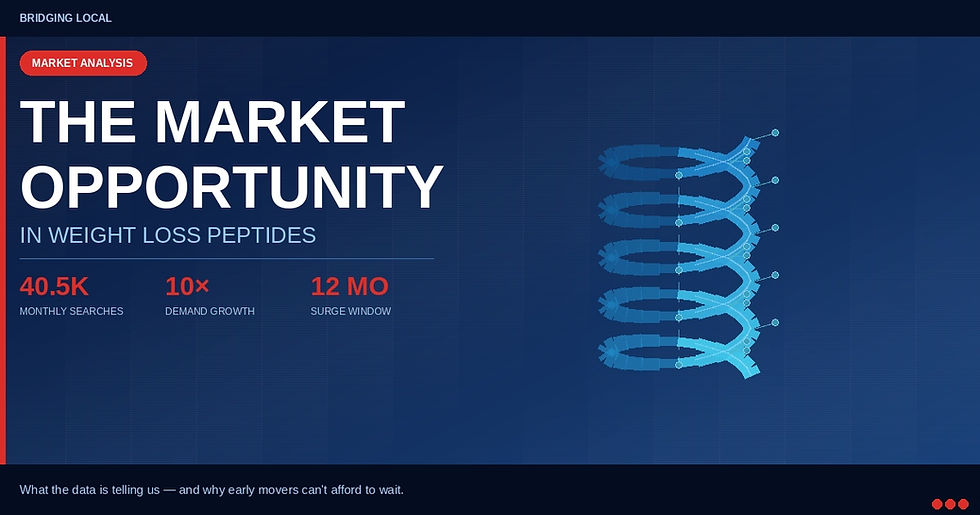
Twelve months ago, "weight loss peptides" was a niche search term typed almost exclusively by biohackers, bodybuilders, and practitioners in integrative medicine. Today it is a mainstream consumer query generating over 40,000 searches every single month and the growth curve shows no sign of flattening.
This kind of demand acceleration does not happen gradually. It happens when a category crosses an awareness threshold, when mainstream media coverage, social proof, and clinical validation arrive at the same time, and when consumers who had previously relied on pharmaceutical options begin actively looking for alternatives.
That is exactly what is happening in the weight loss peptide market in 2026. And for brands, clinics, supplement companies, investors, and entrepreneurs who understand what the data is signalling, the window for early-mover advantage is open right now.
"We are watching a consumer health category move from specialist niche to mainstream demand in real time. The last time we saw a demand curve like this in wellness was the early days of IV therapy and functional medicine clinics."
This article shares the headline signals from our ongoing market intelligence work in this category. It is designed to give founders, business owners, and investors enough context to understand what the opportunity looks like and why the timing matters. For those who want the full picture, the competitor landscape, the regulatory environment, the consumer segmentation, the channel analysis, and the go-to-market intelligence: that is exactly the kind of research Bridging Local builds.
What Is Happening in the Peptide Market Right Now
Peptide therapy is not new. Researchers and practitioners have worked with peptides in clinical settings for decades. What is new is the consumer demand for them, driven partly by the enormous mainstream visibility of GLP-1 receptor agonists like semaglutide and tirzepatide, which have introduced millions of people to the idea that targeted peptide-based interventions can produce meaningful weight loss outcomes.
The ripple effect has been significant. Consumers who understand, or want to understand, the mechanism behind GLP-1 drugs have become intensely curious about the broader peptide landscape. They are researching alternatives, asking their physicians and practitioners about peptide options, and actively seeking out clinics and brands that can provide access.
This has created something unusual in the health and wellness category: a large, motivated, relatively educated consumer base arriving in a market that most established businesses are not yet equipped to serve well.
That gap between demand and supply is where the opportunity lives.
The Demand Signals That Matter
We track consumer demand through multiple signals simultaneously, search volume trends, social media velocity, practitioner inquiry rates, and media coverage patterns. In the weight loss peptide category, multiple signals are moving in the same direction at the same time, which is the combination that indicates a structural shift in consumer behaviour rather than a temporary spike.

A tenfold increase in consumer search demand in under twelve months is one of the clearest early-market signals we track. It tells us that awareness has crossed a threshold and that the consumer base is actively looking for businesses to serve them.
Why This Market Is Moving So Fast
Category demand does not typically move this fast. Understanding why it is happening now is important context for anyone assessing whether and how to enter.
Several forces are converging simultaneously:
The GLP-1 halo effect. Semaglutide and tirzepatide have generated more mainstream media coverage of peptide-based weight management than the entire previous decade of research combined. That coverage has given consumers a framework for understanding how peptides work, significantly lowering the barrier to interest in related therapies.
Access constraints driving exploration. GLP-1 medications remain expensive, supply-constrained, and not universally covered by insurance or provincial health plans. Consumers who are motivated but face access barriers are actively researching alternative peptide options, creating a demand stream that did not exist in the same form eighteen months ago.
The longevity and biohacking mainstream. Consumer interest in performance optimisation, longevity protocols, and body composition management has moved decisively from niche subcultures into mainstream wellness. Peptides sit squarely in this cultural moment, benefiting from a broader shift in consumer health behaviour.
Telehealth infrastructure maturity. The post-pandemic normalisation of telehealth has made it far easier for consumers to access consultations and prescriptions for therapies that previously required specialist in-person visits. This has expanded the practical accessible market for peptide therapy services significantly.
Creator economy amplification. Health and wellness creators with large followings have adopted peptide therapy content at scale, producing high-volume, high-engagement content that introduces the category to audiences who would never have found it through traditional channels.
The Four Layers of the Opportunity
The weight loss peptide market is not a single opportunity. It is a stack of related opportunities across different business models, customer types, and value chain positions. Understanding which layer aligns with your capabilities is the first step in deciding where to focus.

Who Is Positioned to Win
Not every business that enters this market will benefit equally. The opportunities are real, but they are not evenly distributed. Based on the demand signals and competitive landscape we are tracking, the businesses most likely to capture significant market share share a common set of characteristics.

Risks and Considerations Every Entrant Must Understand
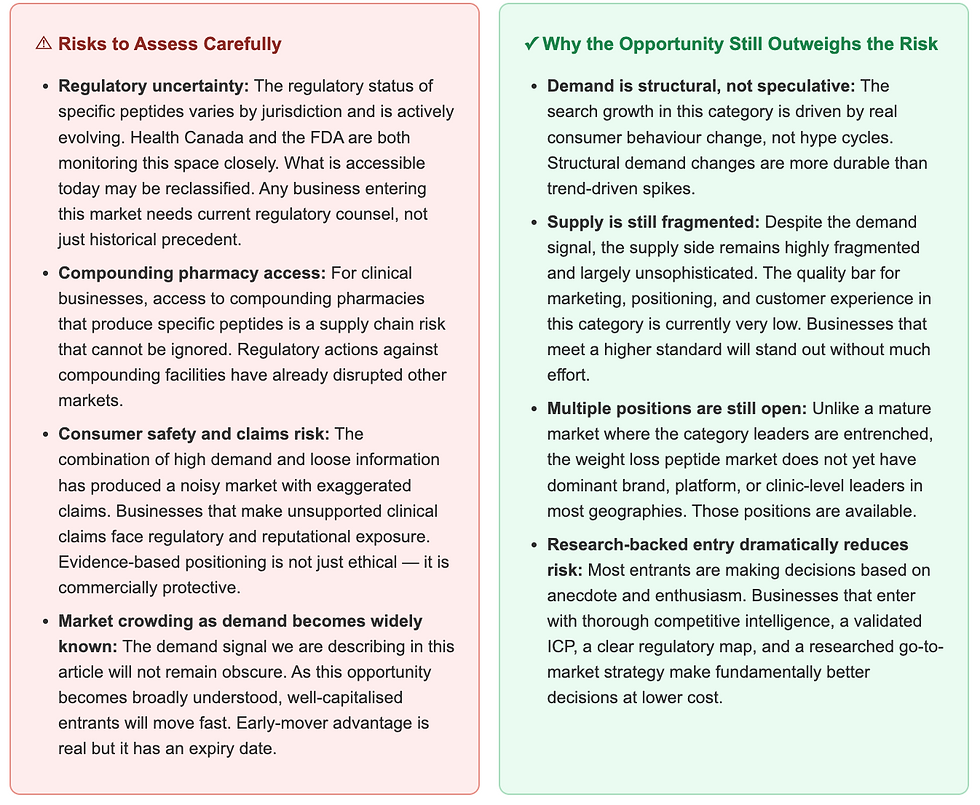
We are not in the business of selling market excitement. Every significant market opportunity comes with risks that must be understood clearly before capital and time are committed. The weight loss peptide market is no exception.
What You Need to Enter This Market Intelligently
Understanding that a market opportunity exists is step one. Knowing how to enter it with precision is step two. The distance between those two steps is where most businesses lose money.
The questions that need to be answered before you commit to entering the weight loss peptide market are specific and consequential:
Who exactly is the consumer in your specific geography and business model? The "weight loss peptide consumer" is not one person. Age, income, health literacy, prior experience with weight loss interventions, and access to healthcare all segment this audience into meaningfully different groups with different needs, different willingness to pay, and different acquisition channels.
What does the competitive landscape look like in your specific market? National-level competitors operate very differently from local clinic competitors. Digital-first platforms compete differently from in-person service providers. Understanding your actual competitive set not the general category, is the basis for every positioning decision you will make.
What are the current regulatory boundaries for the specific business model you are considering? The regulatory framework for a telehealth prescribing platform, a supplement brand, and a compounding pharmacy are completely different. Each path requires specific, current guidance.
Which acquisition channels are producing the best-fit customers in this category right now? The market is evolving fast enough that channel effectiveness is shifting on a quarterly basis. Data-backed channel selection is worth significantly more than it would be in a stable category.
What does pricing look like across the landscape, and where is the underserved value tier? Are there consumer segments being underserved by current pricing structures? Is there a premium segment with unmet quality expectations? Pricing research in a fast-moving category reveals opportunities that are invisible from the outside.
⚠ A Note on Moving Fast
The instinct in a fast-moving market is to enter quickly before the window closes. That instinct is understandable but the risk it creates is real. The businesses that enter fast and underprepared spend the next twelve months correcting positioning mistakes, discovering regulatory constraints they did not account for, and competing on channels their customers do not use. The businesses that take four to six weeks to do the research enter with a strategy that works from day one.
What the Full Research Reveals
The demand signals described in this article are the publicly visible surface of a much more detailed market intelligence picture. Our full research into the weight loss peptide and peptide therapy market covers the complete competitive landscape, consumer segmentation, channel analysis, regulatory mapping, pricing benchmarks, and go-to-market recommendations that a business actually needs to make informed entry decisions.
We are sharing the headline signals here because they are genuinely significant and because founders and business owners deserve to know when a real market opportunity is forming. But the strategic detail, the information that actually shapes positioning, channel, and pricing decisions, is the work we do with clients, not content we publish publicly.
What the Full Research Reveals?
The demand signals described in this article are the publicly visible surface of a much more detailed market intelligence picture. Our full research into the weight loss peptide and peptide therapy market covers the complete competitive landscape, consumer segmentation, channel analysis, regulatory mapping, pricing benchmarks, and go-to-market recommendations that a business actually needs to make informed entry decisions.
We are sharing the headline signals here because they are genuinely significant and because founders and business owners deserve to know when a real market opportunity is forming. But the strategic detail, the information that actually shapes positioning, channel, and pricing decisions is the work we do with clients, not content we publish publicly.
Want the Full Market Intelligence Picture?
Our complete peptide market research engagement covers everything a founder, clinic owner, brand, or investor needs to enter this market with confidence and precision.
Full consumer segmentation: who is buying, why, and at what price point
Competitive landscape map: who is already operating and where the gaps are
Regulatory environment: current status across Canadian and US jurisdictions
Channel analysis: which acquisition channels are producing the best-fit customers
Pricing benchmarks: what the market is charging and where the value gaps are
Go-to-market recommendations, how to position, launch, and scale in this category
Frequently Asked Questions
Is the weight loss peptide market a sustainable opportunity or a trend?
The demand drivers we are tracking: GLP-1 awareness, access constraints, the longevity and biohacking mainstream, and telehealth infrastructure maturity, are structural forces rather than trend-driven spikes. Structural demand changes persist after the media cycle moves on. That said, the regulatory environment is evolving and specific peptide categories face more uncertainty than others. A research-backed view of the sustainable vs trend-dependent segments of this market is something we can provide in a formal engagement.
Can a small clinic or startup enter this market, or is it only for large businesses?
The current state of the market actually favours smaller, agile entrants over large incumbents. The category does not yet have dominant players in most geographies. A well-positioned local clinic, a focused DTC supplement brand, or a telehealth startup with a clear differentiation thesis can establish a meaningful market position with resources that a large incumbent would not allocate to an emerging category. The window is particularly open for businesses that move with a clear strategy rather than waiting for the market to mature around them.
How quickly is this market moving?
The growth from 3,700 to 40,500 monthly searches in twelve months is one of the fastest category-level demand accelerations we have tracked in the health and wellness space. Markets that move this fast typically see competitive consolidation begin within 18 to 24 months of the demand inflection point. That timeline suggests the window for establishing a meaningful first-mover position is measured in months, not years.
What does Bridging Local's market research engagement for this sector cover?
Our peptide market research engagements are tailored to the specific business model and geography of each client. A clinical practice has different research needs than a supplement brand or a technology platform. In all cases, we cover the consumer landscape, competitive analysis, regulatory environment, channel intelligence, pricing benchmarks, and go-to-market strategy relevant to the client's specific entry point. Most engagements are completed in two to three weeks. Book a free consultation to discuss your situation specifically.
Is Bridging Local providing regulatory advice on peptide therapy?
No. We provide market intelligence, competitive analysis, and go-to-market strategy. Regulatory advice requires licensed legal and regulatory counsel. We work alongside your regulatory advisors to ensure the go-to-market strategy we develop for you is built within the boundaries they define, rather than across them. We can also connect clients with regulatory consultants who specialise in the health product and clinical services space.
Conclusion: The Data Is Clear: The Question Is Whether You Move on It
A tenfold increase in consumer search demand in twelve months is not a signal you see every year. In the health and wellness market, it is the kind of inflection that precedes a period of rapid category growth, competitive consolidation, and market-defining brand formation.
The businesses that will look back on 2026 as the year they established their position in the weight loss peptide market will not be the ones that waited for the opportunity to be obvious. They will be the ones that saw the signal early, did the research to understand it precisely, and moved with a strategy built on data rather than excitement.
The signal is clear. The research to act on it intelligently is available. The window is open.
If you are a clinic owner, a founder, a supplement brand, or an investor who wants to understand this opportunity in full detail, we would like to talk to you.
Ready to Explore This Market With Real Data Behind You?
Bridging Local builds the market intelligence that turns a compelling signal into a confident strategy. Book a free consultation and let us show you what the full picture looks like for your specific business model and geography.


Comments