How to Do a Competitor Analysis for Small Businesses: A Step-by-Step Framework


Your competitor just launched a new service. They dropped their prices. They are showing up at the top of Google in your city. And you found out because a customer mentioned it, not because you were watching.
That is a painful but familiar story for most small business owners. You are busy running the business. Monitoring competitors feels like a luxury. But here is the thing: your competitors are shaping what your customers expect from you whether you are watching or not.
A proper competitor analysis for small businesses does not have to be complicated, expensive, or time-consuming. Done right, it takes a few hours to set up and maybe thirty minutes a month to maintain and it gives you a permanent strategic edge over every competitor who is not doing it.
This guide gives you the complete framework: how to find your real competitors, what to look for, how to organise what you find, and most importantly how to turn those insights into decisions that grow your business.
Knowing your competition is not about copying them. It is about understanding the battlefield well enough to find the ground nobody else is standing on.
What Is a Competitor Analysis?
A competitor analysis is a structured process of identifying who you are competing against, understanding how they operate, and using that knowledge to make smarter decisions about your own business.
For a small business, this means researching:
Who your competitors are: both obvious and not-so-obvious
What they offer: products, services, pricing, and packages
How they market themselves: channels, messaging, and positioning
What their customers say about them: reviews, complaints, and praise
Where they are strong and more importantly, where they are weak
The output is not just a report you file away. It is a clear picture of where you fit in the market, what you should do differently, and where the best opportunities for growth are hiding.
Why Small Businesses Can't Afford to Skip Competitor Analysis
Large corporations have entire teams dedicated to competitive intelligence. As a small business, you have something they do not: speed and flexibility. But only if you know what you are reacting to.
Here is what competitor analysis actually gives you in practice:
Smarter pricing: You stop guessing and start pricing based on what the market actually supports and where you can justify charging more.
Better positioning: You find the angle that makes you different and say it clearly, instead of sounding like everyone else in your market.
Fewer surprises: When a competitor launches something new, you see it coming or you have already thought through how to respond.
Stronger marketing: You know exactly what gaps your competitors leave in their messaging and you fill them.
More confident decisions: Whether you are launching a new service, expanding to a new location, or changing your prices competitor data makes the decision cleaner.
Your customers are comparing you to your competitors right now: on Google, on review sites, and in conversation. Competitor analysis tells you what they are seeing when they do.
Direct vs Indirect vs Future Competitors
Before you start researching, you need to know who belongs on your list. Not everyone who operates in your category is a meaningful competitor and some of your most dangerous competitors are not even in your category yet.
Type | Who They Are | Example |
Direct competitors | Same product or service, same target customer, same geography | Another physiotherapy clinic two blocks away |
Indirect competitors | Different product or method, but solving the same customer problem | A fitness studio that offers injury recovery programs |
Future competitors | Not competing today but likely to enter your market soon | A national physio chain opening a franchise in your area |
Replacement competitors | An entirely different solution your customer might choose instead | A customer choosing to manage their injury with YouTube exercise videos |
For most small businesses, your list should include 3 to 7 direct competitors and at least 2 to 3 indirect ones. Any more than that and you will drown in data. Any fewer and you will miss important signals.
Step 1: Find Your Real Competitors
Search the Way Your Customers Search
The most important competitors are the ones your customers find when they are looking for what you offer. Open an incognito browser window (so your personalised history does not distort results) and search for your core service in your city.
Use search queries like:
"[your service] in [your city]"
"best [your service] near me"
"[your service] [your neighbourhood]"
"[your service] [your city] reviews"
Write down every business that appears in the Google Map Pack (the three listings with a map), the first page of organic results, and Google Ads. These are the businesses stealing clicks from you every day.
Also Do This
Check Review Platforms and Directories
Search your category on Yelp, Google Business Profile, Facebook, and any industry-specific directories. Sort by rating and by number of reviews to find the strongest players in your local market. Also check who is running ads on Facebook and Instagram, search your service category on Facebook's Ad Library (it is free) to see what competitors are actively spending money promoting.
Pro Tip: Ask your last five customers: "Before you chose us, who else did you consider?" The names they give you are your most important competitors, because they are the ones your actual customers are comparing you to.
Step 2: Gather Intelligence on Each Competitor
Build a Profile for Each Competitor
For each competitor on your list, you want to answer the same set of questions. Create a simple spreadsheet with one row per competitor and one column per data point. Here is exactly what to capture:
Data Point | Where to Find It |
Services / products offered | Their website, menu, or services page |
Pricing (if visible) | Pricing page, booking page, or call to enquire |
Service area / locations | Website footer, Google Business Profile |
Years in business | About page, LinkedIn company page |
Team size | LinkedIn, About page |
Google star rating + review count | Google Maps |
What customers praise most | 5-star Google and Yelp reviews |
What customers complain about | 1 and 2-star Google and Yelp reviews |
Their unique selling proposition | Homepage headline and About page |
Current promotions or offers | Website homepage, social media |
How fast they respond to enquiries | Submit a contact form and time the response |
Step 3: Analyse Their Online Presence
Website, SEO, and Social Media Audit
Your competitor's online presence tells you a great deal about how seriously they take customer acquisition and where they are leaving doors open for you.
Website and SEO
For each competitor, check:
Is their website mobile-friendly? Over 60% of local searches happen on mobile. A poor mobile experience is a gap you can exploit.
How fast does it load? Run their URL through Google PageSpeed Insights (free). Slow sites lose customers and rank lower on Google.
What keywords are they ranking for? Use Ubersuggest or Semrush (both have free tiers) to see which search terms bring them organic traffic.
Do they have a blog or content hub? Businesses that publish helpful content consistently build compounding SEO advantages. If competitors do not have one, that is your opportunity.
How optimised is their Google Business Profile? Do they have photos, services listed, posts, Q&A responses, and a high review count? If not, you can outrank them by simply having a better profile.
Social Media Presence
Which platforms are they active on? (Facebook, Instagram, LinkedIn, TikTok)
How often do they post and what type of content gets the most engagement?
How many followers do they have, and is that audience growing or flat?
Do they respond to comments and messages? (A competitor with poor social responsiveness is an easy win for you.)
Are they running paid ads? (Check Facebook Ad Library at facebook.com/ads/library, it is completely free.)
Quick Win If your top competitor has 50 Google reviews and you have 12, getting your review count up is the single fastest thing you can do to compete more effectively, before you change a single thing about your product or service.
Step 4: Study Their Customers (Not Just the Business)
Read Every Review Like a Researcher
Competitor reviews are one of the most underused research tools available to small businesses and they are completely free. Do not just look at the star rating. Read the actual text of reviews, especially the negative ones.
What to look for in positive reviews:
Which specific staff members, services, or experiences do customers mention by name?
What language do satisfied customers use to describe the value? (This is the exact language you should use in your own marketing.)
What did the competitor do that exceeded expectations?
What to look for in negative reviews:
What do customers complain about repeatedly? (Waiting times, pricing surprises, communication issues, inconsistent quality?)
How does the business respond or do they not respond at all?
Are there patterns in the complaints that reveal a structural weakness in their business model?
Every recurring complaint in a competitor's reviews is a direct brief for how you should position your own business. If customers constantly mention that your competitor is slow to respond make "same-day response guaranteed" your headline.
Step 5: Build Your Competitor Profile Matrix
Organise Everything Into One View
All the data you have gathered needs to live in one place you can actually use. A competitor matrix is a simple table that lets you compare all competitors side by side across the dimensions that matter most to your business.
Here is a template you can copy into Google Sheets right now:

Once every row is filled in, patterns will emerge immediately. You will see which competitor dominates on price, which owns reputation, which is weakest on digital presence and most importantly, where the gap is that none of them are filling.
Step 6: Find the Gaps and Act on Them
Turn Competitive Intelligence Into Strategy
Data without action is just trivia. The whole point of competitor analysis is to make better decisions. Here is how to turn your matrix into concrete next steps.
Look for these four types of gaps:
Service gaps: Is there a service your customers want that nobody in your market offers well? A restaurant town with no strong vegetarian option. A row of physio clinics with no one specialising in sports injury. These are white space opportunities.
Quality gaps: Is everyone in your market delivering a mediocre experience in one area: booking process, follow-up communication, after-service support? Owning that dimension gives you a reputational edge that is hard to copy.
Price gaps: Is there a viable segment being underserved because all the competitors are priced too high or too cheap? A premium positioning gap or an accessible entry-level gap can both be profitable.
Visibility gaps: Are your competitors almost invisible online: poor Google profiles, no content, weak social presence? This is the most actionable gap for most small businesses, because digital visibility is largely within your control and compounds over time.
The Golden Rule Do not try to compete on every dimension. Pick the one or two gaps where you can genuinely be better than anyone else in your market, make that your headline, and build everything your service, your marketing, your reviews strategy around owning that position.
Step 7: Set Up Ongoing Competitor Monitoring
Make It a Habit, Not a Project
A competitor analysis done once and forgotten is almost useless. Markets change. Competitors pivot. New players enter. The businesses that maintain a lasting competitive edge are the ones that check in regularly not obsessively, but consistently.
Set up these free monitoring systems today and spend 30 minutes per month reviewing them:
Google Alerts: Set up a free alert at google.com/alerts for each competitor's name. Get an email every time they are mentioned online in news, blogs, or directories.
Follow their social media: Follow every competitor on Instagram and Facebook from a personal account. Their posts will appear in your feed. Note when they launch something new, run a promotion, or get high engagement.
Check their Google reviews monthly: New reviews reveal new customer priorities, service changes, and emerging weaknesses. Takes five minutes.
Track their Google rankings quarterly: Use Ubersuggest or Google Search Console (free) to see if competitors are climbing or falling for your target keywords.
Visit their website quarterly: Look for new pages, service additions, pricing changes, and new testimonials or case studies.
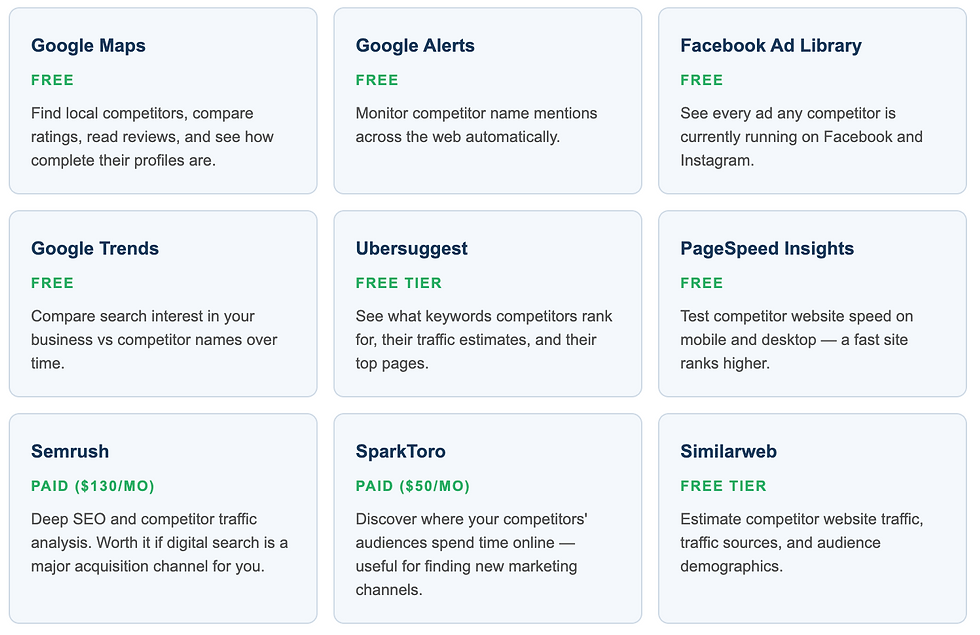
The Best Free and Paid Tools for Small Business Competitor Analysis
You do not need to spend a lot of money. Here are the tools we recommend, starting with the completely free ones:
Competitor Analysis by Industry: What to Focus On
The framework above works for every small business, but each industry has specific competitive signals worth prioritising. Here is what matters most in each sector:
Industry | Most Important Competitive Signals |
Restaurants & Cafés | Google review count and rating, delivery platform presence (DoorDash, Uber Eats), menu pricing, social media engagement, response rate to reviews |
Healthcare Clinics | Wait time mentions in reviews, insurance/billing ease, specialist availability, Google Business Profile completeness, RateMDs or Healthgrades presence |
Spas & Wellness Studios | Service menu breadth, membership offers, booking ease (online booking available?), photography quality on Instagram, treatment trend adoption |
Mental Wellness / Therapy | Modalities offered, sliding scale or insurance acceptance, therapist credentials highlighted, wait time reputation, telehealth availability |
Bakeries & Specialty Food | Custom order capability, allergen-friendly options, farmers market and wholesale presence, packaging and branding quality, Instagram following |
Retail Stores | Product range, pricing vs online alternatives, in-store experience reviews, loyalty program, Google Shopping presence |
Trades & Home Services | Google review volume and recency, response time to quote requests, HomeStars/Angi ratings, licensing and insurance highlighted, emergency service availability |
Professional Services | Niche or specialisation clarity, client testimonials, thought leadership content, fee transparency, LinkedIn company page activity |
E-commerce & Product Brands | Amazon review volume and rating, pricing and shipping speed, product photography quality, return policy, subscription/loyalty offering |
Non-Profits | Donor transparency (Charity Navigator rating), program outcome reporting, community partnership visibility, grant funding breadth, social media engagement |
Common Competitor Analysis Mistakes Small Businesses Make
Only looking at who you know. The most dangerous competitor is often one you are not aware of a newer business, an indirect substitute, or a national brand entering your local market. Search with fresh eyes, not assumptions.
Obsessing over the biggest competitor. The market leader is not always your most relevant comparison point. The competitor closest to your own size, positioning, and target customer is usually the most instructive one to study.
Copying instead of differentiating. Competitor analysis should tell you what not to do as much as what to do. If your three top competitors all lead with "family-owned and friendly service," that messaging is invisible, not a differentiator.
Doing it once and forgetting it. A competitor analysis from two years ago is nearly useless. Markets move fast. The monitoring systems in Step 7 exist precisely to prevent this.
Focusing only on features and ignoring customer feelings. The review research in Step 4 is where the real gold is. The emotional language customers use about your competitors reveals what actually drives their decisions and that is where your positioning should live.
Getting paralysed by what competitors do well. You are not trying to beat every competitor at everything. You are trying to find the specific ground where you can be meaningfully better for a specific customer. Small, focused advantages compound into durable businesses.
Frequently Asked Questions
How many competitors should I include in my analysis?
For most small businesses, three to seven direct competitors is the right range. Fewer than three and you miss important market signals. More than seven and you will produce too much data to act on. Start with your top five and go from there.
How long does a competitor analysis take for a small business?
Your first full analysis, covering five competitors across all the steps in this guide will take around four to six hours spread over a few days. After that, monthly monitoring takes about thirty minutes. The return on that time is enormous relative to the investment.
Can I do a competitor analysis for free?
Yes. Google Maps, Google Alerts, Facebook Ad Library, Google Trends, Ubersuggest's free tier, and the review platforms are all free. A thorough analysis costs nothing but time. Paid tools like Semrush add depth on SEO and digital traffic, but they are not necessary for most local small businesses.
What do I do with my competitor analysis once it is done?
Use it to make one to three specific decisions: a positioning change, a service addition, a pricing adjustment, or a marketing priority shift. If your analysis does not lead to at least one concrete action, you either did not go deep enough or did not ask the right questions at the start.
Should I share my competitor analysis with my team?
Absolutely. The competitive landscape is not just a leadership concern, it affects how your front-line staff answers customer questions, how your salespeople handle objections, and how your marketing team frames your messaging. A shared understanding of the competitive environment makes your whole team sharper.
Is competitor analysis the same as market research?
Competitor analysis is one component of broader market research. Market research also includes customer research, market sizing, trend analysis, and go-to-market strategy. Competitor analysis tells you about the landscape; market research tells you about the entire opportunity.
Conclusion: Knowledge Is Your Cheapest Competitive Advantage
Most small businesses are running blind setting prices based on gut feel, marketing without knowing what their competitors are saying, and discovering competitive threats after their customers already know about them.
A proper competitor analysis changes that. It does not require expensive tools, a large team, or weeks of work. It requires a structured approach, a few hours of focused effort, and the discipline to maintain it as a monthly habit rather than a one-off exercise.
The seven steps in this guide give you everything you need: find your real competitors, build detailed profiles, analyse their digital presence, mine their customer reviews for strategic intelligence, build a comparison matrix, identify the gaps, and set up ongoing monitoring.
Do this well, and you will stop reacting to what your competitors do and start making moves they have to react to.
If you would rather have a professional competitive analysis done for your business with a full competitor matrix, positioning map, and go-to-market recommendations, the team at Bridging Local delivers exactly that, typically in under two weeks.


Comments