Market Sizing 101: TAM, SAM, SOM Explained for Startup Founders

Walk into any investor pitch meeting and within the first five minutes, someone will ask: "How big is the market?"
Most founders fumble this answer. They quote a giant industry figure from a research report "the global wellness market is worth $4.5 trillion" without explaining how much of it they can actually reach, capture, or defend. Investors see through this immediately. And it kills deals.
TAM, SAM, and SOM are the three numbers that answer the market size question properly. They tell investors and more importantly, tell you whether your startup is targeting a market large enough to build a meaningful business in, realistic enough to actually reach, and specific enough to execute against.
But these numbers are not just for pitch decks. They are the foundation of your pricing strategy, your hiring plan, your revenue forecasts, and your go-to-market sequencing. Founders who understand market sizing think differently about their business more rigorously, more honestly, and more strategically.
"Investors don't fund markets. They fund founders who understand their markets with enough precision to actually capture a piece of them."
This guide covers everything: what each term means, how to calculate each one using both major methodologies, worked examples across six industries, how to present the numbers in a pitch, and the most common mistakes that undermine credibility. By the end, you will have the framework to build a market sizing analysis that stands up to scrutiny from investors, partners, and yourself.
If you want a professional market sizing analysis built for your specific startup, Bridging Local's research team delivers investor-ready TAM/SAM/SOM analysis as part of our full market research engagements.
Why Market Sizing Is Non-Negotiable for Startups
Market sizing is not a box-ticking exercise for pitch decks. It is a fundamental act of strategic honesty that every founder owes themselves before committing years of their life to building a company.
Here is what knowing your TAM, SAM, and SOM actually gives you:
A reality check on your ambition. A market that sounds exciting might be too small to support a venture-scale business or too fragmented for a single company to capture meaningfully. Sizing tells you before you find out the hard way.
A ceiling for your revenue model. You cannot build a $50M ARR SaaS business in a $30M market. Market sizing sets the upper bound on what is possible and forces your revenue model to be honest.
A framework for prioritisation. When you know the relative size of different segments within your market, you can prioritise which to target first and which to expand into later based on data, not intuition.
Investor credibility. A well-constructed, defensible market sizing analysis signals that you think rigorously. Investors fund founders who think rigorously. A sloppy market size slide signals the opposite.
A benchmark for traction. Once you know your SOM, your early revenue becomes meaningful, you are not just making money, you are capturing a calculable share of a defined opportunity.
The Three Numbers: TAM, SAM, SOM at a Glance

Think of the three as concentric circles, each one nested inside the previous. TAM is the largest outer circle the entire universe of potential value. SAM is a smaller circle inside it, the portion you can actually reach. SOM is the smallest inner circle, the realistic near-term prize you are targeting.
Each number serves a different purpose. TAM demonstrates the size and legitimacy of the opportunity. SAM validates that you are not going after a niche too small to build on. SOM is the number your year-one and year-three revenue forecasts need to be anchored to.
TAM vs SAM vs SOM: The Funnel Visualised

How to Calculate TAM, SAM, and SOM
There are two widely used methods for calculating market size, and they work best when used together. The top-down approach starts from macro industry data and narrows down. The bottom-up approach builds from first principles using real customer and pricing data. Investors strongly prefer and often require the bottom-up approach, but both are useful at different stages.

Method 1: The Top-Down Approach, Step by Step
Here is exactly how to execute a top-down market sizing analysis:
Find a credible industry-wide market figure. Use sources like Statista, IBISWorld, Grand View Research, MarketsandMarkets, or industry association reports. Look for the total annual revenue in your product or service category. Note the year and geography of the figure.
Define your TAM. If the report covers global revenue and your category matches your product exactly, this is your TAM. If your product is a subset of a broader category (e.g., your product is an HR software for restaurants, not all HR software), apply a percentage estimate to narrow the category to your specific sub-segment.
Narrow to SAM using your specific filters. Apply the following constraints in sequence:
Geography: What percentage of the global market is in your target region? (e.g., Canada represents approximately 2.5% of global GDP.)
Language/culture: Does your product require a specific language or cultural context?
Product scope: Does your product serve the full category or a specific use case within it?
Price point: Does your pricing exclude certain segments (too expensive for SMBs, or too cheap for enterprise)?
Estimate SOM using a realistic market share. Research what market share comparable early-stage companies achieved in their first one to three years. For most B2B SaaS startups, 1-5% of SAM in year three is a credible range. For consumer products, 0.1-1% is more typical. Apply your estimate and multiply it against your SAM.
⚠ Top-Down Trap: The single biggest mistake in top-down analysis is applying a percentage to a number that is already wrong. If the industry report is measuring the wrong category, or is five years old, your entire analysis is built on a flawed foundation. Always check the methodology, date, and definition of the source figure before you use it.
Method 2: The Bottom-Up Approach (The One Investors Trust)
The bottom-up approach builds your market size from the ground up using real, defensible inputs. It is more work but it produces numbers you can actually stand behind in a pitch meeting.
Define your specific customer segment precisely. Not "small businesses", but "independent restaurants in Canada with 1-3 locations that do not currently use a digital reservation system." The more specific, the more defensible.
Count how many of them exist. Use LinkedIn Sales Navigator, Statistics Canada, the US Census Bureau's business data, industry association member counts, or market research databases. If you cannot find an exact count, triangulate from multiple sources and state your methodology.
Multiply by your annual revenue per customer. Use your actual pricing (or planned pricing), not an industry average. If you charge $300/month, your annual contract value (ACV) is $3,600. If you sell a one-time product at $250, use that.
That product is your SAM. It represents the total annual revenue available if you served every customer in your defined segment at your price point.
Apply a realistic capture rate to reach SOM. Research comparable companies at a similar stage. Consider your sales capacity, your marketing budget, your competitive position, and how quickly customers in this segment typically make purchasing decisions. Apply a percentage of SAM you can credibly capture in year one and year three separately.
The bottom-up approach forces you to know your customer with precision. Founders who can say "there are 12,400 businesses in Canada that match our ideal customer profile, and we need to convert 2.4% of them in year one to hit our revenue target" are the ones who get taken seriously.
Worked Examples Across 6 Industries
Abstract frameworks are only useful when you can see them applied to real situations. Here are six complete TAM/SAM/SOM calculations across different startup types, using the bottom-up method where possible.
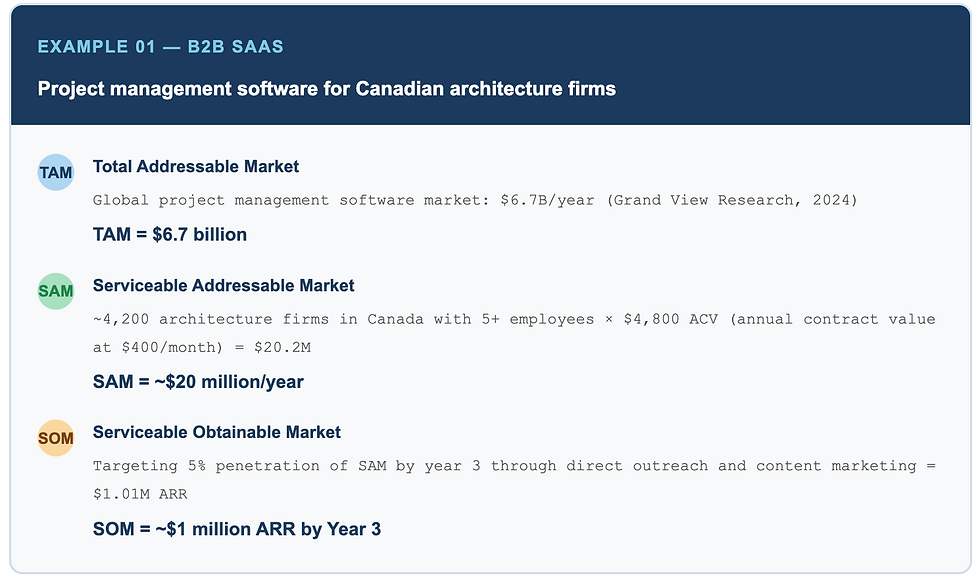

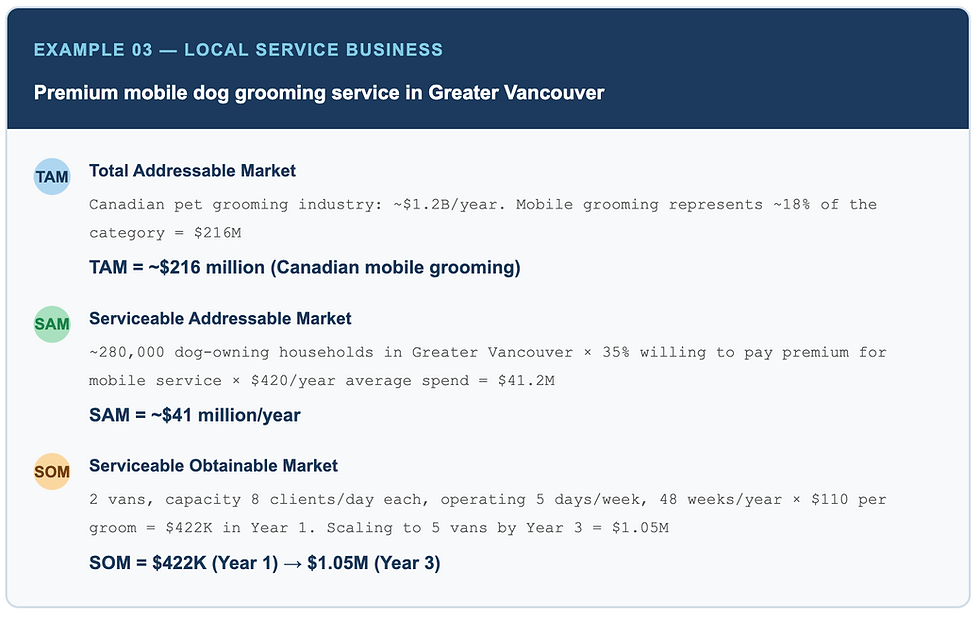


How to Present Market Sizing to Investors
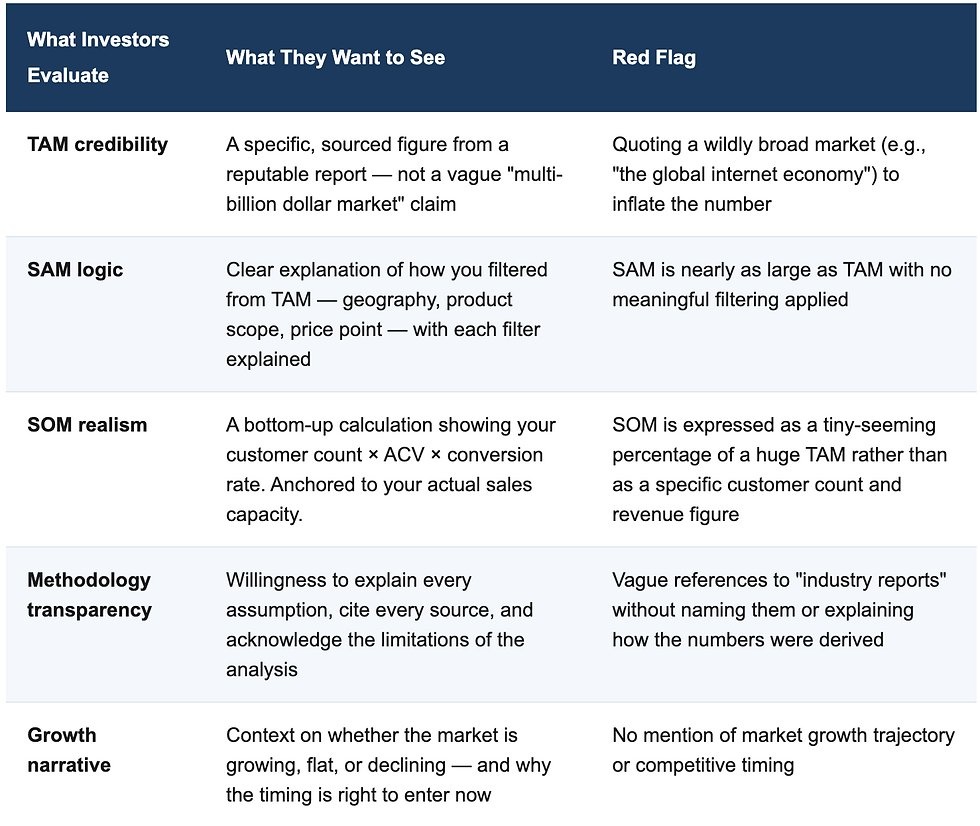
Knowing your numbers is one thing. Presenting them in a way that builds confidence — rather than triggering scepticism, is a different skill. Here is exactly what investors want to see and hear when you present market sizing.

The 7 Biggest Market Sizing Mistakes Startup Founders Make
01
The "1% of a huge market" fallacy
Saying "If we just capture 1% of the $10 billion market, that's $100 million" is the most common and most damaging market sizing error. It tells investors nothing about how you will acquire customers, why 1% is achievable, or what the path to capture looks like. Always show your customer count, not just a percentage.
02
Using outdated or irrelevant market reports
A market sizing figure from 2019 is five years old in a fast-moving category. A "global" figure applied to a local market is wrong by an order of magnitude. Always check the date, geography, and methodology of your sources — and use the most recent data available.
03
Defining TAM so broadly it is meaningless
Claiming the global healthcare market or the global software market as your TAM when you are selling a niche product to a specific sub-segment signals either strategic confusion or deliberate inflation. Both destroy credibility. TAM should describe the realistic category your product competes in.
04
SAM = TAM with no filtering
If your SAM is 80% or more of your TAM, you have not done the filtering work. SAM should reflect real constraints, your geographic coverage, your language, your product scope, your price point. Investors who see a SAM nearly as large as TAM know the analysis was not done rigorously.
05
SOM that ignores sales capacity
A two-person founding team cannot realistically close 5,000 enterprise customers in year one regardless of market size. Your SOM must be constrained by your actual sales capacity, how many customers your team can acquire, onboard, and retain given your headcount, budget, and sales cycle length.
06
Not accounting for competition in SOM
Your SOM is not your share of an empty market. There are competitors already serving it. Your SOM should reflect what you can win from the existing competitive landscape — which means understanding how much share leaders already hold and how defensible that share is.
07
Treating market sizing as a one-time exercise
Markets change. New categories emerge. Competitors collapse or consolidate. Your TAM, SAM, and SOM should be updated at least annually, and certainly before any fundraising round. Numbers that made sense at pre-seed may be significantly wrong by Series A.
Data Sources and Tools for Market Sizing Research
The quality of your market sizing is only as good as the data behind it. Here are the most reliable sources, organised by cost and use case:
Source | Cost | Best For |
Statistics Canada | Free | Canadian business counts by NAICS code, industry revenue, employment by sector, essential for Canadian SAM calculations |
US Census Bureau (business data) | Free | US business counts, industry revenue, and demographic data for US market sizing |
Google Trends | Free | Search demand trends over time useful for validating whether a category is growing or declining |
Statista | Paid annual plan US$ 2,300+ | Quick industry-level market size figures, majority of their data is sourced from free sources and also contradicts their own data |
IBISWorld | Paid (US$ 2000+/report) | Generic Industry reports with 5-year forecasts and basic competitive structure |
LinkedIn Sales Navigator | $99+/mo | Count exact numbers of businesses or professionals matching your ICP criteria, gold standard for bottom-up B2B SAM |
Crunchbase | Free tier / $49/mo | Startup and investment data, useful for mapping competitive landscape and validating category growth through funding activity |
Grand View Research / MarketsandMarkets | $5,000+ report | Market forecasts with CAGR projections, but expensive just for one or two data; look for excerpts in press releases |
Industry association reports | Often free to members | The most accurate data for specific verticals, often published annually by trade associations in your sector |
Bridging Local Market Research | Custom engagement | Full custom market report including market sizing with primary and secondary research, bottom-up validation, and investor-ready presentation format |
Frequently Asked Questions
How big does my TAM need to be to raise venture capital?
There is no universal TAM threshold. What matters to an investor depends on their fund size, investment stage, sector focus, and return expectations, all of which vary significantly. A $50M seed fund and a $2B growth equity fund are asking completely different questions when they look at your market size slide. What every investor does care about, regardless of fund size, is whether your SAM and SOM are realistic and defensible, whether the market is growing, and whether your specific path to revenue makes sense. A large TAM with a vague go-to-market is far less compelling than a more modest TAM with a precise, credible capture strategy. Focus on building a rigorous bottom-up SOM rather than inflating your TAM to hit an imagined threshold.
What is a realistic SOM for a startup in year one?
This depends heavily on sales cycle length, deal size, and go-to-market motion. For B2B SaaS with a direct sales model, 0.5-2% of SAM in year one is defensible for an early team. For consumer DTC, 0.1-0.5% is typical. For local service businesses, SOM is better expressed as a capacity-constrained revenue figure rather than a percentage, build it from your operational capacity, not from a percentage of a large number.
Should I include future product lines in my TAM?
Only if you are within 18-24 months of launching them and have a concrete plan. Investors are sophisticated enough to understand that a platform company's eventual TAM is larger than its initial product's TAM but they will scrutinise claims about future expansion aggressively. Present your current product's TAM as the primary number and reference the expansion opportunity separately.
My market is very niche is a small SAM a problem?
Not necessarily. A small but highly concentrated, high-value, fast-growing niche can support an excellent business, especially if you are not pursuing venture capital. Many great businesses are built on SAMs of $20-100M. The key question is whether your SOM can generate enough revenue to cover your costs and growth at a realistic market share. If yes, a small SAM is not a problem, it is a focus.
Can Bridging Local help me build a TAM/SAM/SOM analysis for my startup?
Yes, it is one of the most common deliverables in our startup market research engagements. We build both top-down and bottom-up analyses, source every figure, and deliver the output in a format ready for a pitch deck or investor data room. Most engagements are completed in two to three weeks. Book a free consultation to discuss your specific needs.
Conclusion: Know Your Numbers Before Anyone Else Asks
TAM, SAM, and SOM are not investor buzzwords. They are the answer to the most important question in business: is there a market large enough, reachable enough, and specific enough for this company to be built?
Founders who know their market sizing numbers with precision, who can walk through the calculation, defend every assumption, and explain what the SOM means for their year-one revenue target, are founders who have done the work. That work shows. In pitch meetings, in strategy sessions, and in the daily decisions that compound into a real company.
The bottom-up approach is harder than pulling a number from a report. It requires you to know your customer count, your price point, and your realistic conversion rate. But that difficulty is precisely what makes it valuable, because the work of calculating your SOM from first principles forces you to understand your market at a level that most of your competitors never will.
Start with what you know. Build from the ground up. Triangulate with top-down data. Update it as you learn. And if you want a professional team to do the analysis for you, in a format that will stand up to the most rigorous investor scrutiny, Bridging Local is here to help.


Comments