SWOT Analysis for Startups: How to Do It Right?

SWOT analysis is the most widely used strategic framework in business, and it is also the most widely misused. Ask any founder to produce a SWOT for their startup and you will typically get four boxes filled with generic statements: "passionate team" under Strengths, "limited budget" under Weaknesses, "growing market" under Opportunities, and "competition" under Threats.
That is not analysis. It is merely a list of obvious facts arranged in a grid.
A properly conducted SWOT analysis is one of the most useful strategic exercises a startup can run. It forces you to confront honest assessments about your position, connect internal capabilities to external market conditions, and surface strategic moves that would not be obvious from any single perspective. But it only works if you do it with rigour, specificity, and evidence rather than opinion.
"A SWOT analysis is only as good as the research behind it."
This guide shows you how to run a SWOT analysis that actually produces strategic insight. It includes over 60 prompting questions across the four quadrants, a complete worked example, the TOWS matrix that turns your SWOT into actionable strategy, and the mistakes that make most startup SWOT analyses worthless.
If you want the research foundation that makes a SWOT genuinely rigorous, Bridging Local's market research services deliver the competitive intelligence and market analysis that a strong SWOT depends on.
What Is a SWOT Analysis?
SWOT is a strategic planning framework that examines four dimensions of a business situation: Strengths, Weaknesses, Opportunities, and Threats. It was developed at the Stanford Research Institute in the 1960s and remains widely used because the structure is simple and the output is genuinely useful when the inputs are rigorous.
The framework works by separating factors along two axes. The first axis is internal versus external. The second axis is helpful versus harmful. Every factor you identify belongs in exactly one of the four resulting quadrants.

Why Most Startup SWOT Analyses Are Useless?
The framework is sound. The execution is usually where things break down. Here is what goes wrong in most startup SWOT sessions:

The difference is specificity and evidence. A generic entry tells you nothing you can act on. A specific, evidence-backed entry points directly to a strategic decision.
⚠ The Specificity Test Every entry in your SWOT should pass this test: could a competitor write the exact same thing on their SWOT? If yes, the entry is too generic to be useful. "Passionate team" fails this test because every startup would write it. "Two founders with prior operational experience inside our target customer type" passes because it is specific to your situation.
The Critical Distinction: Internal vs External
The single most common structural error in SWOT analysis is misclassifying factors between the internal and external axes. Getting this wrong undermines the entire exercise, because the strategic response to an internal factor is fundamentally different from the response to an external one.
The rule is simple: Strengths and Weaknesses are things you control. Opportunities and Threats are things you do not control.
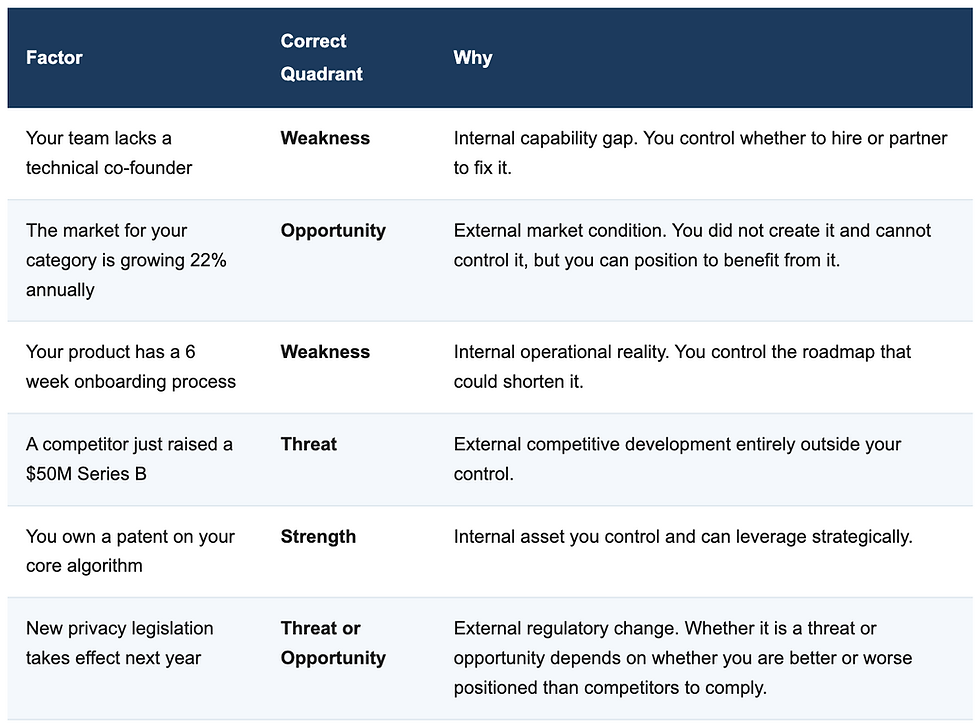
That last row illustrates an important nuance. The same external development can be an opportunity for one company and a threat for another. Regulatory tightening that burdens your competitors more than you is an opportunity. Regulatory tightening that burdens you more than incumbents is a threat. Your classification should reflect your relative position, not the abstract nature of the change.
Strengths: Questions to Ask
What do we do measurably better than every competitor we have analysed, and what evidence supports that claim?
What specific expertise, credentials, or prior experience does our team have that a competitor would struggle to replicate?
What do our existing customers say we do well? What language do they use in reviews, testimonials, or renewal conversations?
Do we own any proprietary technology, IP, patents, data, or processes that create a defensible advantage?
What relationships, partnerships, or distribution access do we have that competitors do not?
Where are our unit economics better than the category average, and why?
What can we do faster, cheaper, or at higher quality than the alternatives our customers currently use?
Do we have proprietary data or accumulated learning that improves our product over time?
What is our customer retention or NPS relative to category benchmarks?
What have we already proven that competitors have only claimed?
What structural advantage does our size, focus, or geography give us against larger incumbents?
Where do we have brand credibility, reputation, or trust with a specific audience segment?
💡 Evidence Rule for Strengths Every strength should be supported by something external to your own opinion. Customer testimonials, retention data, competitive benchmarking, published credentials, patent filings, or measurable performance data. If the only evidence for a strength is that your team believes it, it is a hypothesis, not a strength.
Weaknesses: Questions to Ask
What capabilities does our team not have that this business fundamentally requires?
What do competitors offer that we cannot currently match, and how often does that come up in sales conversations?
What are the most common reasons we lose deals? What did the customer say when they chose someone else?
What do our negative reviews, churned customers, and support tickets consistently reveal?
Where in our funnel do we lose the most people, and do we understand why?
What parts of our operation depend on one person, one supplier, or one channel?
How long is our runway, and what happens to our strategy if we cannot raise on schedule?
What technical debt, product gaps, or scalability limits will constrain us in 12 months?
Where are our unit economics worse than the category average, and why?
What compliance, regulatory, or certification requirements do we not currently meet?
What do we consistently avoid talking about in investor conversations because we do not have a good answer?
If a competitor were writing a battle card against us, what would they put on it?
That last question is the most valuable in the entire framework. Competitors are strongly motivated to identify your weaknesses accurately, and thinking from their perspective often surfaces things internal teams are reluctant to say out loud.
Opportunities: Questions to Ask
Which customer segments are underserved by current market offerings, and how large are they?
What recurring complaints appear in competitor reviews that no one in the market has solved?
What regulatory, policy, funding, or tax changes are coming that could favour our position?
What shifts in customer behaviour or expectations are creating new demand we could capture?
Are any competitors struggling, contracting, being acquired, or moving out of our segment?
What adjacent products or services could we offer to our existing customer base?
What emerging technology could we adopt earlier than competitors to create an advantage?
Are there geographic markets where our category is underdeveloped relative to demand?
What partnerships or distribution channels are available that competitors have not secured?
Is there a category or positioning claim that no competitor has credibly occupied yet?
What acquisition channels are currently underpriced or underused in our category?
Are there structural changes in the buyer landscape such as consolidation, new buyer types, or budget shifts that we could benefit from?
Opportunities should come from research, not brainstorming. Competitor review mining, regulatory tracking, search demand analysis, and customer interviews produce opportunity insights that no internal discussion will surface.
Threats: Questions to Ask
Which competitors have recently raised capital, and what does their hiring pattern signal about their strategic direction?
Could a large incumbent add our core feature as a checkbox in their existing product?
What regulatory changes could restrict our business model, increase our compliance costs, or block our market access?
What technology shifts could make our current approach obsolete within three years?
How dependent are we on a single platform, supplier, partner, or distribution channel that could change terms or cut us off?
What happens to our demand in an economic downturn? Is our product discretionary or essential to our customers?
Are new entrants appearing in our category, and what advantages do they have that we do not?
Could our customers solve this problem themselves or with free tools if our pricing rises?
What concentration risk exists in our customer base? What percentage of revenue comes from our top three accounts?
Are talent, input costs, or acquisition costs rising in ways that erode our margins?
What reputational or trust risks exist in our category that could affect us even if we did nothing wrong?
Could a shift in consumer sentiment or media narrative damage demand for our category?
How to Run a SWOT Session Properly
Step 01
Do the Research First, Not During the Session
The most common failure mode is treating the SWOT session as the research. It is not. Before you gather your team, complete the underlying research: competitor analysis, customer interview synthesis, review mining, win and loss data, market trend research, and regulatory monitoring. The session is where you interpret evidence, not where you generate opinions.
Step 02
Define the Scope Precisely
A SWOT for "our company" is too broad to be actionable. Define the specific question first: SWOT for entering the Ontario market, SWOT for our enterprise product line, or SWOT for our position against a named competitor. A narrow scope produces specific, decision-relevant output. A broad scope produces generic filler.
Step 03
Include People Who Will Disagree With You
A SWOT session run only with founders produces an optimistic Strengths list and a thin Weaknesses list. Include your sales lead who hears objections daily, your support lead who hears complaints, and ideally an external advisor with no emotional investment in the answers. Disagreement in the room improves the output.
Step 04
Write Everything, Then Ruthlessly Prioritise
Generate freely in the first pass without filtering. Then apply two filters. First, cut anything that fails the specificity test. Second, rank what remains by materiality: how much would this actually change our strategy if it were true? Keep the top five to seven items per quadrant and discard the rest. A SWOT with 40 entries is a list. A SWOT with 20 well-chosen entries is a strategic document.
Step 05
Do Not Stop at the Grid
A completed SWOT grid is an input, not an output. The strategic value comes from the next step: connecting quadrants to each other through the TOWS matrix to generate specific strategic actions. Most startups fill in four boxes, feel productive, and never return to it. That is the step that wastes the whole exercise.
A Complete Worked Example
Here is a SWOT analysis for a fictional but realistic startup, showing the level of specificity that makes the exercise useful.

Notice that almost every entry contains a number, a source, or a specific observable fact. This is what separates a SWOT that drives decisions from one that fills a slide.
The TOWS Matrix: Turning SWOT Into Strategy
This is the step almost every startup skips, and it is where the actual strategic value lives. The TOWS matrix takes your four SWOT quadrants and cross-references them to generate four categories of strategic action.

Work through each quadrant pairing and write two to three specific strategic actions for each. You will typically end up with eight to twelve candidate strategies, which you then prioritise by impact and feasibility. That prioritised list is the real output of a SWOT exercise. The grid was only the input.
7 Mistakes That Ruin a Startup SWOT
Writing generic entries that any competitor could also write. "Passionate team" and "growing market" are not analysis. If a competitor could put the same line on their SWOT, delete it and replace it with something specific to your actual situation.
Confusing internal and external factors. Putting "strong competition" under Weaknesses is a classification error that breaks the framework. Competition is external, so it belongs under Threats. Your inability to differentiate against that competition is the internal weakness.
Running it as a brainstorm instead of a research synthesis. A SWOT built from a whiteboard session with no underlying research produces a well-organised list of assumptions. Do the competitive analysis, customer research, and win and loss review first, then hold the session.
Being dishonest about weaknesses. Founders systematically underweight the Weaknesses quadrant because it is uncomfortable and because investors sometimes see the document. Write the honest version for internal use. A sanitised SWOT is strategically worthless.
Producing too many entries. A SWOT with 40 items across four quadrants is unusable. Force yourself to the five to seven most material items per quadrant. Everything else is noise that dilutes the important signals.
Stopping at the grid. The four boxes are the input. The TOWS matrix and the resulting prioritised strategy list are the output. Startups that stop at the grid have completed an exercise, not produced a strategy.
Doing it once and never revisiting it. A SWOT reflects a moment in time. Competitors raise money, regulations change, your team capabilities evolve. Review and update your SWOT at least twice a year and before every significant strategic decision.
When to Use SWOT and When Not To

Frequently Asked Questions
How many items should each SWOT quadrant contain?
Five to seven per quadrant is the practical range. Fewer than three suggests you have not researched thoroughly enough. More than eight suggests you have not prioritised. The goal is to surface the factors that are material enough to change a strategic decision, not to catalogue everything that could conceivably be relevant.
Should I show my SWOT analysis to investors?
You can, but do it deliberately. Investors respond well to founders who demonstrate honest self-awareness about weaknesses and threats, provided each one is paired with a credible mitigation plan. What damages credibility is a SWOT where the Weaknesses quadrant contains only soft items like "we need to hire more people" while the Strengths quadrant is full of unsupported superlatives. Keep an unfiltered internal version and a well-prepared external version that is honest but paired with your responses.
How often should a startup update its SWOT analysis?
At minimum twice a year, and additionally before any major strategic decision such as a new market entry, a significant product direction change, or a fundraising round. Early-stage startups change faster than established businesses, so factors that were accurate six months ago may be materially outdated. A competitor raising a large round, a regulatory change, or the addition of a key hire can all shift multiple quadrants.
What is the difference between SWOT and TOWS?
SWOT identifies factors. TOWS generates strategies from those factors by cross-referencing the quadrants. SWOT tells you that you have a strong domain reputation and that a market segment is underserved. TOWS turns that into a specific action: use the domain reputation to enter the underserved segment through a targeted campaign. SWOT is the analysis, TOWS is the strategy generation. Doing SWOT without TOWS is the most common reason founders find the exercise unsatisfying.
Can Bridging Local do a SWOT analysis for my business?
Yes. SWOT analysis is a standard component of our market research engagements, built on top of the competitive intelligence, customer research, and market analysis that make a SWOT rigorous rather than speculative. We deliver the completed SWOT alongside a TOWS strategy matrix with prioritised recommended actions. Book a free consultation to discuss your situation.
Conclusion: SWOT Is Only as Good as What Goes Into It
The reason SWOT has survived for six decades is that the underlying logic is sound. Separating what you control from what you do not, and what helps from what harms, is a genuinely useful way to structure strategic thinking.
The reason SWOT has a reputation for being a superficial exercise is that most people fill it in from memory, in a room, in twenty minutes, and never do anything with the result.
The difference between those two outcomes is research and follow-through. Do the competitive analysis, the customer interviews, the review mining, and the win and loss review first. Write entries specific enough that a competitor could not copy them. Prioritise ruthlessly. Then work through the TOWS matrix to convert the analysis into a prioritised list of strategic actions.
Done that way, a SWOT analysis is one of the highest-value strategic exercises available to a startup. Done the usual way, it is four boxes of things you already knew.
If you want the research foundation that makes the difference, Bridging Local can help.


Comments