Go-to-Market Strategy for Startups: The Complete Step-by-Step Guide

Most startups do not fail because they built a bad product. They fail because they brought a good product to market in the wrong way, for the wrong customer, through the wrong channels, at the wrong price.

That is a go-to-market problem. And it is entirely preventable.
A go-to-market (GTM) strategy is the operational plan that answers the most consequential questions your startup faces before launch:
Who exactly are we selling to?
How do we reach them? What do we say?
What do we charge?
How do we close the first hundred customers and then the next thousand?
Done well, a GTM strategy is not a lengthy document that sits in a shared drive. It is a working framework your entire founding team uses to make decisions every day, updated as you learn, and grounded in real market research rather than assumptions about who you think your customer is.
"A great product without a great GTM strategy is an invention. A great product with a great GTM strategy is a business."
This guide walks you through every component of a startup go-to-market strategy from the ground up, with a framework you can apply regardless of what you are building, who you are selling to, or what stage you are at. And if you want the research that powers each component done professionally, Bridging Local's market research team has helped over 400 startups and SMBs build research-backed GTM strategies across every major industry.
What Is a Go-to-Market Strategy?
A go-to-market strategy is the plan a startup uses to bring its product or service to market and acquire its first customers. It defines who you are targeting, how you will reach them, what you will say, what you will charge, and in what sequence you will execute.
It is different from a marketing plan, which focuses only on promotion. It is different from a business plan, which focuses on the full financial model and company structure.
A GTM strategy is specifically focused on the question: how do we get from zero to traction?

A GTM strategy is not written once and forgotten. The best founders treat it as a living document that gets sharper as they learn from customers, from sales conversations, and from what the data shows about which channels and messages are actually working.
Why Most Startups Get GTM Wrong
The most common reason startup GTM strategies fail is not that they are poorly executed. It is that they are built on assumptions that were never tested.
Founders assume they know who their customer is. They assume they know what message will resonate. They assume the channel that worked for a company they admire will work for them. They assume their pricing is right because it feels competitive. None of these assumptions cost anything to make and all of them can cost everything if they are wrong.
The founders who build GTM strategies that work do one thing differently: they treat every component of the strategy as a hypothesis to be validated through research before they commit resources to executing it. They talk to potential customers before they set the price. They test the messaging before they build the campaign. They research the channel before they hire for it.
That is exactly what this guide shows you how to do.
The 6 Core Components of a Startup GTM Strategy
Every effective startup go-to-market strategy, regardless of industry or business model, is built from the same six components. Each one depends on the one before it, which is why the sequence matters as much as the content.

Step 1: Define Your ICP and Beachhead Market

The most important thing to understand about beachhead selection is that it is not about limiting your ambition. It is about creating the conditions for genuine traction. A startup that owns one segment completely has proof of concept, case studies, and word-of-mouth momentum. A startup that targets five segments simultaneously has shallow penetration in all of them and proof of nothing.
To define your ICP for GTM purposes, answer these questions with precision:
Who experiences the problem most acutely? Not everyone in your broad market feels the pain equally. Who loses the most when this problem is unsolved?
Who has the budget and authority to buy the solution? Intense pain plus no purchasing power equals a frustrating pipeline. Your ICP must be able to pay.
Who can you reach with the resources you have right now? The best beachhead is one you can actually access, not just the one that sounds most exciting in a pitch deck.
Who will refer others if they are delighted? Word-of-mouth is the most efficient growth channel a startup has. Choose a beachhead where satisfied customers move in the same networks.
💡 Research This
Before committing to your beachhead, conduct 15 to 20 discovery interviews with people who match your ICP hypothesis. Ask about their problem, their current solution, and their budget for fixing it. The answers will sharpen your beachhead definition faster than any internal discussion will.
Step 2: Build Your Positioning Statement

A positioning statement is an internal strategic tool, not a piece of customer-facing copy. It is specific, explicit, and written for clarity rather than persuasion. The most widely used format comes from April Dunford's work on positioning:

Notice how specific that is. It names the exact customer, the exact problem, the exact alternative, and the exact differentiator. This level of specificity is what allows every piece of marketing copy, every sales conversation, and every product decision to stay aligned with who you are actually for.
To write your positioning statement well, you need research. Specifically, you need to know what language your ICP uses to describe their problem, what alternatives they are currently using, and which differentiators they actually care about versus which ones you only think they should care about. That knowledge comes from customer interviews, competitive analysis, and review mining, not from internal brainstorming sessions.
Step 3: Choose Your Pricing Model and Price Point

A product priced at $29 per month attracts a different buyer, with different expectations, a different risk tolerance, and a different conversion journey, than the same product priced at $500 per month. Your pricing must be aligned with your ICP, your positioning, and your sales motion simultaneously.
Key pricing decisions your GTM strategy must address:
Model: Per seat, usage-based, flat rate, tiered, freemium, or value-based. Each model creates different growth dynamics and different customer relationships. Research which model your ICP is most familiar and comfortable with before choosing.
Price point: Research willingness to pay before you set a number. The Van Westendorp method (four questions that reveal the acceptable price range without anchoring to a number) is the most reliable approach for early-stage startups without historical sales data.
Free trial structure: Time-limited trial, usage-limited freemium, or no free access at all. This decision depends on your product's time-to-value, your ICP's risk tolerance, and whether your category has established free-tier norms.
Entry point vs expansion: What is the lowest-friction way to get a customer in the door, and what is the natural expansion path once they are there? Land-and-expand strategies require deliberate packaging research.
⚠ Common Pricing Mistake
Founders almost universally underprice in the early stages. The instinct is to make the price as low as possible to reduce friction and grow faster. But underpricing attracts the wrong customers, signals low quality to the buyers you actually want, and creates a revenue base that cannot support the sales and customer success motion your product requires. Research your willingness to pay before you anchor to a number.
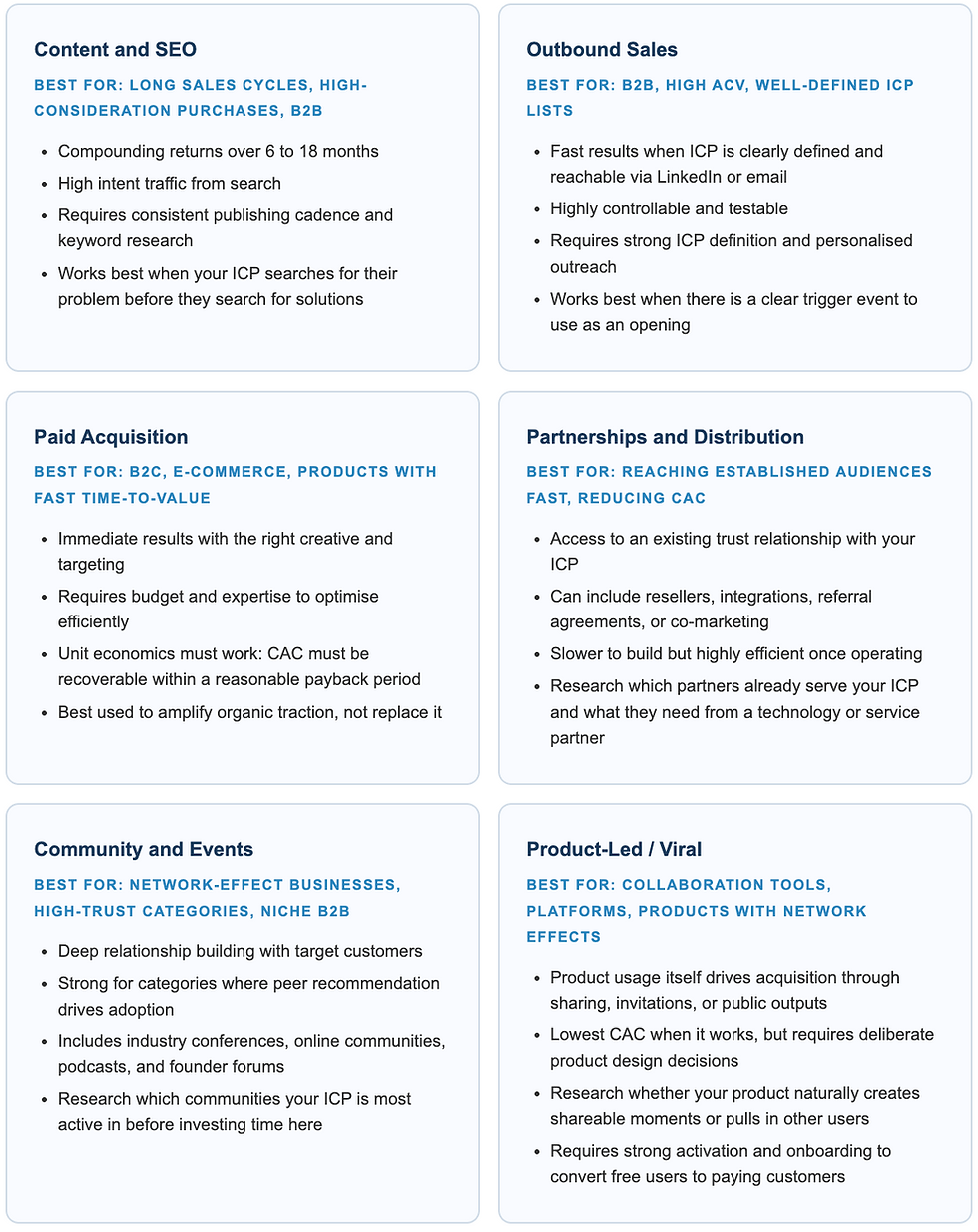
Step 4: Select Your Primary Acquisition Channels

Research your channel selection by asking potential customers directly: "When you last looked for a solution to [the problem], how did you find it? What did you search for? Who did you ask?" Their answers will almost always point to two or three channels that dominate discovery in your category.
Start there.
💡 Channel Research Rule
Pick one or two channels to go deep on first, not five channels to go shallow on. Most successful startups build their first hundred customers through a single, well-executed channel before diversifying. The data from that first channel also teaches you which other channels your customers respond to.
Step 5: Define Your Sales Motion

The key questions to research for your sales motion:
How long does the buying decision typically take? A two-day decision requires a completely different sales process than a three-month procurement cycle. Research this by asking past customers in your discovery interviews: "How long did it take from first learning about a solution like this to signing a contract?"
Who is involved in the decision? In B2B, map the full buying committee. Who initiates the evaluation, who influences it, who has veto power, and who signs? Each stakeholder needs a different message and a different touchpoint in your sales motion.
What information does the buyer need at each stage? Awareness content, comparison content, objection-handling content, and proof content serve different stages of the buying journey. Mapping the journey tells you what to produce and in what sequence.
What are the most common objections and when do they surface? Research this from your early sales conversations and from competitor reviews. Knowing objections in advance means your sales motion addresses them proactively rather than reactively.
The output of this research is a simple three to five stage pipeline that mirrors how your ICP actually buys. For most early-stage B2B startups this looks like: Awareness, Consideration, Evaluation, Decision, and Onboarding. For B2C or PLG products it is typically: Discovery, Sign-up, Activation, Retention, and Expansion. The specific stages matter less than the research behind what drives movement between them.
Step 6: Build Your Launch Sequence

01
Pre-Launch: Research and Foundation (Weeks 1 to 4)
Before a single customer-facing activity, complete the research that every other step depends on.
Finalise ICP definition and beachhead market based on discovery interviews
Complete competitive analysis and identify your positioning gap
Write the positioning statement and extract three to five core messages
Research and set pricing based on willingness-to-pay data
Identify the top one to two acquisition channels your ICP actually uses
02
Soft Launch: First Customers (Weeks 4 to 8)
Activate your warm network and earliest channels to acquire your first 10 to 20 customers. These customers are your research subjects as much as they are your revenue.
Reach out directly to people in your network who match the ICP
Use early adopter communities (Product Hunt, relevant Slack groups, Reddit) for B2C or prosumer products
Run highly personalised outbound outreach to a short, curated list for B2B
Conduct structured onboarding conversations with every early customer to capture feedback
Document what works and what does not in obsessive detail
03
Growth Launch: Channel Activation (Weeks 8 to 16)
With early customer data in hand and positioning validated, activate your primary acquisition channel at scale.
Launch your content and SEO program based on keyword research from customer language
Activate paid acquisition with messaging validated through early customer conversations
Formalise your outbound sales motion with templated but personalised sequences
Begin building one or two strategic partnership conversations
Publish first case studies using early customer results
04
Scaling: Optimisation and Expansion (Weeks 16 onward)
Use data from the first three months to double down on what is working and cut what is not.
Analyse CAC, conversion rates, and time-to-close by channel and ICP segment
Identify the highest-retention ICP cohorts and refine targeting around them
Research the next adjacent segment to expand into after the beachhead is established
Begin building a referral or partner program using the warm relationships from early customers
Update pricing if early data shows consistent willingness to pay above your current price
GTM Metrics Every Startup Should Track
A GTM strategy without measurement is a guess. These are the metrics that tell you whether each component of your strategy is working, and which part of the funnel needs attention.

GTM Strategy by Startup Type
The core components of a GTM strategy apply universally, but the execution looks quite different depending on what you are building and who you are selling to. Here is how the key decisions typically break down by startup type:

The 7 Biggest GTM Mistakes Startups Make
01
Building the GTM after the product instead of alongside it
Your go-to-market strategy should be taking shape at the same time as your product. The ICP you define in week one shapes the features you prioritise. The pricing model you research in month two shapes the product tiers you build. GTM is not a post-launch activity. It is a design input.
02
Targeting everyone in the name of not excluding potential customers
Broad targeting produces generic messaging that resonates with nobody. The founders who go narrow and specific in their beachhead selection close deals faster, generate better word-of-mouth, and build the case studies that eventually open up broader markets. Narrowness is a launch strategy, not a ceiling.
03
Copying a competitor's GTM without understanding why they chose it
A competitor's channel mix, pricing model, and sales motion reflects their history, their cost structure, their ICP, and their mistakes, none of which you fully understand from the outside. Research your own buyers independently and let the data guide your GTM decisions rather than pattern-matching to a company whose context you do not have.
04
Activating too many channels simultaneously
Five channels executed poorly produces worse results than one channel executed brilliantly. Early-stage GTM requires concentration. Pick the one or two channels most likely to reach your ICP efficiently, go deep, learn everything about what works, and only diversify once you have channel-market fit on the first one.
05
Writing messaging based on features rather than outcomes
Your customers do not buy features. They buy the outcome those features produce. "Real-time project profitability tracking" is a feature. "Know exactly which clients are eroding your margin before the invoice goes out" is an outcome. The language of outcomes comes from customer research, specifically from listening to how customers describe the cost of the problem in their own words.
06
Treating the launch as the destination
Launch day is not the goal. It is the starting gun. The founders who treat launch as a destination celebrate for a day and then coast. The founders who treat launch as the beginning of a learning process use every customer interaction, every lost deal, and every support ticket as data to sharpen the GTM strategy in real time.
07
Skipping the research that every GTM decision depends on
Positioning built without customer research is guesswork. Pricing set without willingness-to-pay research is speculation. Channel selection made without understanding where your ICP actually discovers solutions is wishful thinking. The research investment is small relative to the cost of executing a GTM strategy built on wrong assumptions.
How Market Research Powers Every Part of Your GTM
A go-to-market strategy is only as strong as the research that built it. Every component we have covered in this guide has a direct research input that either validates the decision or changes it before you spend money executing it.

This is precisely why professional market research is not a luxury for funded startups. It is the foundation on which every GTM decision stands. The cost of getting these decisions wrong after launch, in wasted marketing spend, in the wrong hires, in a product built for the wrong customer, is orders of magnitude higher than the cost of researching them correctly before you begin.
Frequently Asked Questions
How long does it take to build a go-to-market strategy for a startup?
The research and strategic thinking behind a solid GTM strategy takes two to six weeks depending on how much primary research is needed and how clearly the ICP is already defined. Writing the strategy document itself is a few days. The more meaningful question is how long it takes to validate it, which is an ongoing process that continues through the first six to twelve months of active selling.
What is the difference between a GTM strategy and a marketing plan?
A GTM strategy covers the full arc from ICP definition and positioning through pricing, channel selection, sales motion, and launch sequencing. It is a strategic document that shapes how the business goes to market across all functions. A marketing plan is a subset of the GTM strategy, focused specifically on the promotional and content activities used to generate awareness and demand. You cannot write a good marketing plan without a clear GTM strategy to anchor it to.
Can a startup have more than one GTM strategy?
Not effectively in the early stages. Different customer segments, geographies, or product lines may eventually warrant different GTM approaches, but early-stage startups that try to run multiple GTM motions simultaneously almost always execute all of them poorly. The discipline of committing to one GTM strategy, learning from it rigorously, and then expanding is what produces durable early traction.
How do I know if my GTM strategy is working?
The leading indicators are conversion rates at each pipeline stage, time to first value, and early retention in the first 30 to 60 days. The lagging indicators are CAC payback period, LTV to CAC ratio, and net revenue retention. If your pipeline conversion rates are healthy but retention is weak, the GTM is working but the product or onboarding is not. If conversion rates are poor, the GTM itself, specifically the positioning, messaging, or channel, needs to be revisited.
Does Bridging Local help with go-to-market strategy for startups?
Yes. Our market research engagements include go-to-market strategy as a deliverable alongside ICP definition, competitive analysis, market sizing, and buyer persona development. We do the research that powers each component of your GTM strategy and deliver it in a format your team can act on immediately. Book a free consultation to discuss your specific situation.
Conclusion: GTM Is Where Strategy Meets Execution
A go-to-market strategy is the bridge between what you have built and the customers who need it. Get it right and every dollar of marketing spend is more efficient, every sales conversation is more focused, and every product decision has a clear customer to build for. Get it wrong and you can spend years executing brilliantly in the wrong direction.
The six steps in this guide give you a complete framework: define your ICP and beachhead with precision, build a positioning statement grounded in real customer language, set a research-backed price, select channels your ICP actually uses, design a sales motion that mirrors how your buyers actually buy, and launch in a sequence that builds on each previous step.
None of these steps require a large budget. They require honest research, clear thinking, and the discipline to stay specific when every instinct tells you to go broad.
If you want the research that powers this framework done by a team that has built GTM strategies across hundreds of startups and small businesses, Bridging Local is ready to help.


Comments