Local Competitor Analysis: How to Find Out Where You Are Losing Customers

Somewhere in your area, a customer who would have called you last year called someone else instead. Then another one did. Nobody told you. There was no moment when it happened. The work just quietly stopped arriving at the same rate.

That is what competitive loss looks like in a local business. It is not dramatic. It is a slow redistribution of the same demand to a different set of businesses, and by the time it shows up clearly in your revenue, it has usually been happening for a year or more.
The good news is that this is one of the most diagnosable problems a small business can have. Your competitors leave evidence everywhere: in search results, in reviews, in their pricing, in what they advertise, in what they hire for.
This guide gives you a seven-step local competitor audit. Worked through properly, it tells you who is actually taking your customers, what they are winning on, and which of those things you can realistically beat them at.
Also, please don’t blindly rely on AI for this or any research. In our experience, AI makes a lot of mistakes, and sometimes these can be major blunders, particularly when it comes to the accuracy of information and data. It’s important to verify the sources and data before using them.
If your sales have dropped and you are not yet sure competition is the cause, start with our diagnostic guide for owners whose sales are down first. Competition is only one of six possible causes and you want to be looking in the right place before you spend a day on this.
Why Local Competitor Analysis Is Different
Most competitor analysis advice online is written for software companies and national brands. It talks about market share, category positioning, and feature matrices. That framework does not fit a business whose customers come from a fifteen minute drive radius.
Local competition works differently in three important ways:
Geography caps the competitive set. You are not competing with everyone in your industry. You are competing with the businesses your customer can realistically reach. That is usually between five and fifteen businesses, which makes a thorough analysis actually achievable.
Search position does most of the sorting. For a national brand, discovery happens across many channels. For a local business, a large share of new customers pick from whatever appears in the map pack when they search. Your competitive position and your search position are far more tightly linked than most owners realise.
Reputation is public and quantified. Your competitors' customers have written down what they think, in detail, with dates and star ratings attached. There is no equivalent dataset in most other kinds of business. Not reading it is leaving free intelligence on the table.
The Four Competitors Taking Your Customers
Before you start looking, be clear about who you are looking for. Owners consistently underestimate their competitive set because they only count the businesses that look like theirs.
💡 Build Your List Like This Aim for five to seven direct competitors and two or three substitutes. Fewer than five and you will miss the pattern. More than ten and you will collect data you never use. If you cannot name seven, that is itself a finding: you are not watching your market closely enough.
The Seven-Step Local Competitor Audit
01
Find Out Who Actually Ranks Above You
Start where your customers start. Open an incognito or private browsing window so your own search history does not distort what you see, and search exactly what a customer would type.
Run these searches
Your main service plus your city
Your main service plus "near me"
Your main service plus each neighbourhood you serve
Your second and third services the same way
Emergency or urgent variations if they apply to your trade
For each search, write down
The three businesses in the map pack, in order
Everyone appearing in the first page of organic results
Anyone running a paid ad at the top
Where you appear, if you appear at all
Do this for every service line and every neighbourhood separately. Owners are often surprised to find they rank well for one service and are invisible for another, or they hold position in their home neighbourhood and disappear two suburbs over.
02
Map Their Trade Area Against Yours
Two competitors with identical services are not equally threatening if one is twenty minutes further from your customers than the other. Geography decides a large share of local competitive outcomes and most owners never map it.
What to do
Plot every competitor on a single map. Google My Maps is free and takes ten minutes.
For each one, check the drive time from the neighbourhoods you consider your core catchment. Not distance, drive time. A competitor six kilometres away across a bridge is further than one ten kilometres away on a straight road.
Identify where their catchment overlaps yours and where it does not. The overlap zone is where you are directly competing. The zones only you cover are your protected territory.
For mobile, contractor and B2B businesses, do the same with stated service territory rather than a fixed address. Most competitors publish their service area on their website.
Note any neighbourhood in your catchment where three or more competitors are closer to the customer than you are. That is territory you are probably already losing.
03
Mine Their Reviews
This is the highest value step in the entire audit and the one most owners skip because it feels tedious. Your competitors' customers have written a detailed account of what that business does well and badly, and published it for you to read.
Read every review for your top five competitors. Pay particular attention to the three and four star reviews, which tend to be the most balanced and revealing. One star reviews are often outliers and five star reviews are often thin.
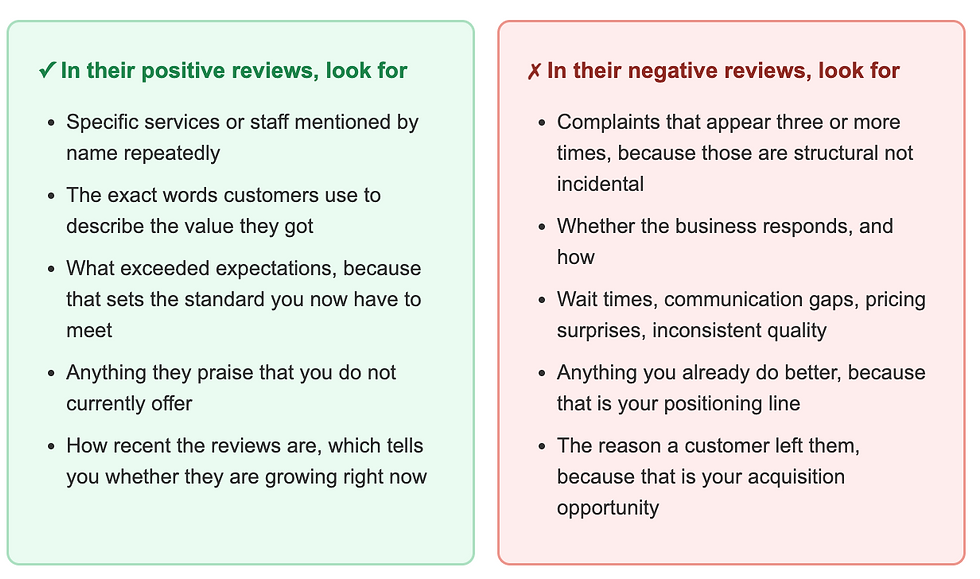
Also record review velocity, not just review count. A competitor with 45 reviews where 30 arrived in the last twelve months is growing fast. A competitor with 200 reviews where the last one was eight months ago is coasting or declining. These are very different threats.
04
Understand Where You Sit on Price
You need to know whether you are priced above, below, or in line with your market. There are several sources that give you a reliable picture. Note not all competitors share pricing information online in such cases you may have to hire agency to get this information.
Where to get real pricing information
Published pricing and starting rates. Many local businesses now publish price ranges, call-out fees, hourly rates, or package pricing directly on their website. Collect what is public and note who publishes nothing, because pricing opacity is itself a positioning choice.
Customer reviews. Customers name figures constantly. "Paid $340 for the service and it was worth it" appears in reviews far more often than owners expect. Across five competitors and a few hundred reviews you can build a genuine price range without contacting anyone.
Your own lost quotes. The single best source. Call the last ten prospects who did not go with you and ask what decided it. Most will tell you, and a meaningful number will tell you the number they were quoted. This is an honest conversation with your own prospect, and it also gives you the reason behind the decision rather than just the price.
Your existing customers. Ask what they were paying before they came to you, or what else they considered. Customers are usually happy to say and it costs you nothing but the question.
Public tender and contract awards. For B2B, government, and institutional work, award values are frequently published. This is the most reliable competitive pricing data available in any category and almost nobody in the SMB world uses it.
Trade and industry association benchmarks. Many associations publish member rate surveys, average job values, or regional pricing guides. Usually free to members and often available more widely.
Look at packaging, not just the number
What is included as standard versus charged as an extra
Whether they quote a fixed price or an hourly rate, because that changes how a customer perceives risk
Warranties, guarantees, callbacks, and follow-up visits
Payment terms and financing options, which frequently decide larger jobs
⚠ Before You React to a Lower Price A competitor appearing cheaper is not automatically winning on price. Check what is included and excluded, and check what their reviews say about the final invoice. A low headline price that becomes an expensive job generates exactly the complaints you can position against. Cutting your own price to match a number that was never really the number is how margin disappears for no gain.
05
Compare Service Menus Line by Line
Open every competitor's services page and list what they offer in a single column next to yours. This is unglamorous and it consistently surfaces the clearest opportunities in the whole audit.
Three things to look for
What all of them offer that you do not. This is table stakes you are missing. Customers comparing options may be filtering you out before they ever call.
What only you offer. This is either your genuine differentiator or a service the market stopped wanting. Check your own sales data to work out which.
What nobody offers. This is potential white space, but treat it carefully. Sometimes nobody offers it because there is no demand, and sometimes because everyone has missed it. That distinction needs evidence before you invest.
Also note convenience features, not just services. Online booking, emergency availability, weekend hours, financing options, warranties, and free estimates all influence choice as much as the service itself. These are frequently where a newer competitor is quietly beating an established one.
06
Check What They Are Spending On
Where a competitor puts their money tells you where they believe their customers are. This is one of the most useful and least used sources of local competitive intelligence.
Free places to look
Facebook Ad Library at facebook.com/ads/library. Completely free and requires no account. Search any business name and see every ad they are currently running on Facebook and Instagram, including how long it has been running. Ads that have run for months are working.
Google search ads. Search your service terms and note who is paying for the top position. Paying consistently means it is profitable for them.
Their job postings. Check Indeed and their website careers page. Hiring more field staff means growth. Hiring a marketing person means they are about to get more visible. Hiring nothing for a year alongside falling review velocity means they may be struggling.
Their Google Business Profile activity. Are they posting updates, adding photos, answering questions, responding to reviews? Active profile management is a signal of a business paying attention, and it directly affects their map pack position against you.
Their website content. Are they publishing? A competitor building a blog or resource section is investing in organic search and will outrank you over time if you are not doing the same.
07
Build the Comparison Grid
Everything you have gathered needs to sit in one view where you can compare it. A spreadsheet is fine. The point is to see all of it side by side, because patterns that are invisible in your notes become obvious in a grid.
Use these rows, one column per competitor plus one for yourself:

Working Out What You Are Actually Losing On
In a local market, customers choose on a small number of dimensions. Your grid will usually point clearly at one of them.
1. You are losing on visibility
Competitors rank above you in the map pack, your Google Business Profile views have fallen, or your review velocity is well behind theirs. Enquiry volume drops but your close rate on the enquiries you do get holds steady. This is often the most recoverable position to be in, provided it is diagnosed correctly. Our digital marketing services cover exactly this work.
2. You are losing on price or packaging
Enquiry volume is steady but your close rate has fallen. Your quotes come in consistently above the market, or a competitor bundles more into the same number. Before cutting your price, check whether the difference is the price or the presentation. Repackaging costs nothing. Discounting costs margin permanently.
3. You are losing on range
Competitors offer services or conveniences you do not, and customers who want a single provider go elsewhere. This shows up as losing whole jobs rather than individual services. Fixable, but the investment case needs demand evidence before you commit.
4. You are losing on responsiveness
The most underestimated factor in local services. In many trades the business that answers first wins the job regardless of price or quality. Customers say this openly in reviews, and lost prospects say it plainly when you ask them why they went elsewhere. If competitors are getting back to people faster than you are, that alone can explain a slowdown. It is also one of the most commonly missed causes.
5. You are losing on geography
Competitors are simply closer to a chunk of your catchment. You cannot fix distance, but you can decide to stop spending money chasing neighbourhoods you are structurally disadvantaged in, and concentrate on the territory where you have the advantage. Sometimes the answer is a second location, and that decision deserves proper analysis.
Keeping It Current
A competitor analysis done once and filed away loses most of its value within a year. The market moves. What you want is a light monthly habit rather than an annual project.

When This Is Not Enough
Everything above is work you can do yourself, and for many businesses it will produce an answer clear enough to act on. Do it, act on it, and do not spend money you do not need to spend.
There are situations where the DIY version runs out of road:
You cannot see why you are losing. You rank well, your prices are in line, your reviews are good, and the work still is not coming. When the visible evidence does not explain it, the answer is usually in customer perception, and finding that requires talking to people in your market who did not choose you.
You are about to spend real money. A second location, a new service line, a rebrand, or a significant marketing commitment. The cost of researching that properly is small next to the cost of getting it wrong.
You are losing bids rather than walk-in work. B2B and contract work hides its competitive intelligence in tender records, award data, and buyer relationships rather than in reviews and map packs. It requires a different method entirely.
You need this to hold up for someone else. A lender, a landlord, a partner, or a franchisor. Your own analysis, however careful, does not carry the same weight as independent research.
At Bridging Local we build the full picture for established businesses: demand and growth signals in your category, competitor pricing and packaging, service changes and search visibility, customer complaints and market gaps, and where the opportunity remains open. You can see the full scope on our market research for small business page.
Frequently Asked Questions
How many competitors should I actually analyse?
Five to seven direct competitors and two or three substitutes. That is enough to see a genuine pattern without producing more data than you will ever use. Prioritise the ones ranking above you in search and the ones closest to your core catchment, because those two groups take the largest share of the customers you are losing.
How do I find out what competitors actually charge?
Use published pricing, price figures mentioned in customer reviews, public tender and contract awards, and industry association rate benchmarks. The most valuable source of all is your own lost quotes. If finding difficult to find pricing info, our market research agency can help.
A competitor has far more reviews than me. How much does that matter?
Review count matters, but recency and velocity matter more. A business with 200 reviews where the most recent is eight months old looks less current to a customer than one with 60 reviews where fifteen arrived this quarter. Recent reviews also carry more weight in local search ranking. If you are behind, focus on building a consistent request habit rather than trying to close a gap of hundreds.
What if my competitors are much bigger than me?
Size is not the advantage owners assume it is in local markets. Larger operators are frequently slower to respond, less flexible on scheduling, more standardised in their service, and less connected to the specific neighbourhood. Read their reviews and you will usually find the complaints cluster around exactly those things. That is where a smaller local business wins.
How often should I redo the full audit?
Do the full seven-step audit once a year, and run the lighter ongoing check in between. Also run the full version whenever something significant changes: a new competitor appears, your revenue shifts noticeably, or you are considering a location, pricing, or service decision that involves real money.
What does Bridging Local provide that this audit does not?
The main additions are customer research and depth. We survey screened residents or interview buyers in your actual trade area, which tells you why people chose a competitor rather than letting you infer it. We add trade area demographics, category demand direction, and for B2B businesses, contract and bid intelligence. And it ends with a go-to-market plan rather than a report. Details are on our small business market research page.


Comments