Canada Bakery Market 2026: A Can$12 Billion Industry Navigating Health Demand, Premiumization, and a Trade War It Did Not Ask For

Canada's baked goods market grew at 7.2% annually between 2020 and 2024. That rate drops to 3.9% through 2029. On the surface, that looks like a category losing momentum. Look closer and a different picture emerges, a market splitting into two distinct tracks, where the brands that understand which track they are on will grow, and the ones that don't will compete on price until the margin disappears.
And then there is the tariff problem. The US absorbs 96% of Canada's baked goods exports. Between early 2025 and mid-2026, American trade policy turned that concentration from an asset into a liability. Canadian exports overall fell 4% in the third quarter of 2025 alone. The bakery sector is caught directly in that number and the escalation has not stopped.
The Canada Bakery Market in Numbers: Can$12.2 Billion in 2025 and Decelerating
Canada's retail baked goods market is estimated at Can$12.2 billion in 2025, heading to Can$14.2 billion by 2029 at a 3.9% annual growth rate. That growth rate is half what it was in the 2020 to 2024 period. It is not a collapse, we need to look it as a maturation signal. The era of broad-based volume expansion in Canadian bakery is ending. What replaces it is a more selective market where growth concentrates in specific categories, specific health claims, and specific consumer segments.

Volume tells the same story from a different angle. Total baked goods volume grew at 2.4% annually from 2020 to 2024 and is forecast to grow at just 1.9% through 2029. Value is growing faster than volume in every major sub-category. That gap is the definition of premiumization, and it is as present in the bakery aisle as it is anywhere else in Canadian food retail.

The categories to watch: Bread and pastries are the two growth engines, forecast at 4.5% and 4.3% respectively through 2029. Cakes, dessert mixes, and frozen baked goods are essentially flat or declining in volume. A product in those latter categories without a clear health or premium angle is not going to get growth from the market itself.
Bread Still Leads the Canadian Bakery Market, But Not the Bread You're Thinking Of
Bread is Canada's largest baked goods category at Can$7.4 billion in 2025, forecast at Can$8.9 billion by 2029. That headline number is accurate and also slightly misleading, because within bread the growth is not evenly distributed.
Flat bread - pita, roti, tortilla is one of the strongest performers in the entire Canadian bakery market. It grew at 9.6% annually between 2020 and 2024 and is forecast to hold 4.5% growth through 2029. The driver is Canada's immigration-led demographic shift. As diverse communities grow in urban centres, the retailers and manufacturers serving their staple bread preferences are capturing real, durable demand that has nothing to do with food trends and everything to do with who is moving into the country.

Pastries reached an estimated Can$2.2 billion in 2025 and are forecast at Can$2.7 billion by 2029. Growth here runs on a different engine: affordable indulgence. As consumers cut back in other food categories, quality pastries at a reasonable price are holding up well. The artisanal segment of this category is outperforming branded consistently.
Health Bakery in Canada: the Can$1.4 Billion Opportunity in Plain Sight
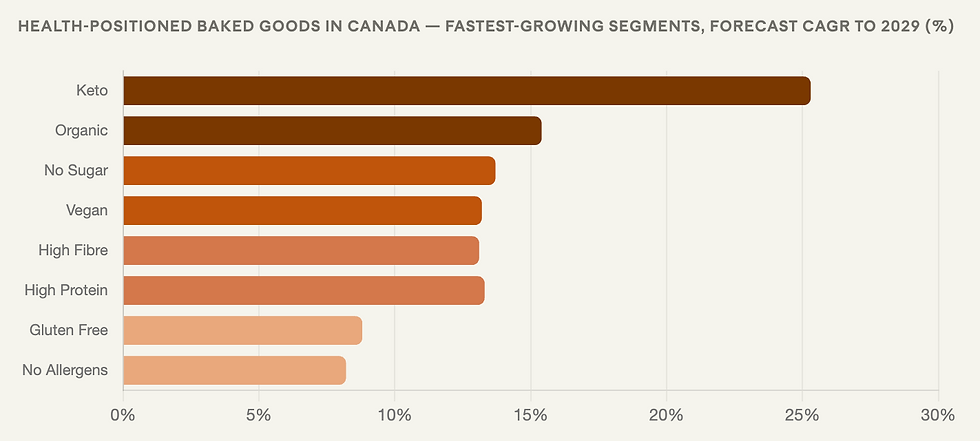
Gluten-free bakery is the largest health segment at an estimated Can$342 million in 2025, growing at 8.8% annually through 2029. Allergy prevalence in Canada is projected to rise to 38.5% of the population by 2029. More Canadians with dietary restrictions means a larger addressable market for gluten-free and allergen-free products every year, independent of any marketing effort from the brands serving them.
The high-growth stories are in smaller but fast-moving segments. Keto baked goods are forecast at 25.3% annually through 2029. Vegan at 13.2%. No-sugar at 13.7%. High-fibre at 13.1%. Organic, despite a contraction between 2020 and 2024, is forecast to rebound at 15.4% through 2029. These are not marginal numbers in a market growing at 3.9% overall.

The allergy math is straightforward. 38.5% of Canada's projected 2029 population of 43 million is over 16.5 million Canadians with some form of allergy. Brands that have built credibility in gluten-free and allergen-free bakery are not chasing a trend. They are building a customer base that grows automatically as the population ages and allergy prevalence increases.
Who Is Winning the Canadian Bakery Market
The competitive landscape in Canadian baked goods is less consolidated than most people assume. The largest single player is not a branded manufacturer. Artisanal products command 34% of the market at Can$3.7 billion in 2025, growing at 6.2% annually since 2020. Independent bakeries, regional chains, and supermarket in-store bakeries collectively outsize every named brand in the country.

Among branded players, Grupo Bimbo leads at Can$1.58 billion and 14.4% market share. Its Dempster's brand alone generates Can$784 million. FGF Brands follows at Can$1.14 billion and 10.3% share. Private label holds 20.4% of the market at Can$2.2 billion. Twenty-seven percent of Canadian consumers plan to buy more private label products, while only 38% express a preference for branded goods. That ratio is not comfortable for any mid-tier branded manufacturer without a clear premium or health story to tell.
The US Tariff Problem: What Happened, What It Costs, and What the Industry Is Doing About It
This is the section that changes the growth story in ways the market data alone does not capture. Canada's baked goods export sector depends on the United States for 96.3% of its Can$7.6 billion in annual shipments. That concentration was a competitive advantage for three decades. Starting in early 2025, it became a structural vulnerability.
The timeline of escalation
Feb 2025
The White House imposes a 25% tariff on most imports from Canada. The American Bakers Association estimates the cost to the US baking industry at US$244 million annually on Canadian goods alone, covering ingredients, packaging, and equipment.
April 2025
Canada implements the United States Surtax Remission Order, providing temporary relief for Canadian bakeries importing US ingredients, equipment, and packaging. The Baking Association of Canada secures extended remission coverage for wheat flour, baking mixes, bakery machinery, and plastic packaging through December 2025.
Q3 2025
Canadian exports overall fall 4% below pre-tariff levels. Bakery and tortilla product sales contract, with the FCC citing a sudden and unprecedented shift in export performance. US unit sales of bread fall 3.4% for the 52-week period ending August 2025, reducing demand for Canadian-manufactured product.
July 20, 2026
The White House invokes Section 338 of the Tariff Act of 1930 to impose 50% additional tariffs on certain Canadian goods, including USMCA-compliant products, removing the trade agreement protection that Canadian exporters had relied on since 2020. Nearly US$20 billion in annual Canadian imports are affected.
Aug 25, 2026
Canada announces counter-tariffs of 15%, 25%, and 50% on Can$27.6 billion in US goods, effective September 8, 2026. Bakery-relevant categories hit directly: baking mixes and doughs (HS 1901.20) face a 50% surtax. Dairy inputs including milk protein, whey, and cheese face 25% to 50% tariffs, raising costs for Canadian bakeries that source US dairy ingredients.

What this actually means for Canadian bakeries
The impact runs in two directions simultaneously. On the export side, Canadian manufacturers shipping finished baked goods to the US face the prospect of a 50% additional cost landing on their American buyers. For perishable products with thin margins and short shelf lives, that arithmetic does not work. The FCC's bakery report noted that the US makes up 50% of total Canadian bakery sales when exports are included, meaning the trade disruption is not a marginal issue. It is a fundamental revenue question for the manufacturers most exposed to the American market.
On the input side, Canadian counter-tariffs on US baking mixes, doughs, and dairy ingredients raise production costs for domestic manufacturers that source American inputs. The 50% surtax on baking mixes and doughs (HS 1901.20) taking effect September 8, 2026 is a direct cost increase for any Canadian baker relying on US-origin mix formulations.

The USMCA shield is gone. For five years, Canadian bakery exporters operated with the assumption that USMCA compliance protected them from the most aggressive US trade measures. The July 2026 Section 338 tariffs removed that assumption explicitly. Goods qualifying for USMCA preferential treatment are no longer exempt. This is not a temporary pause or a negotiating tactic, it is a legal mechanism that predates USMCA and overrides it.
How the industry is responding
The Baking Association of Canada has been direct about what the industry needs to do. The BAC's position, articulated through 2025 and into 2026, is that Canadian bakery must compete on innovation, not price, that the path through trade disruption is product differentiation, not margin erosion. The BAC has been in active talks with Global Affairs Canada to map untapped free trade agreements that could open alternative export markets.
The diversification data supports the urgency. Mexico grew as a Canadian export destination at 115% annually from a small base. South Korea at 25.3%. Japan at 24%. Taiwan at 57.9%. These numbers are still small relative to the US anchor, but they are real footholds. Interest in uniquely Canadian baked goods, Quebec-style brioche, maple-infused formats, artisanal sourdoughs, is growing in Australia, the UK, and parts of Asia. Building those channels takes years, not quarters. The manufacturers starting now are the ones who will have options when the US relationship stabilizes at whatever new level it reaches.
Domestically, the Bank of Canada noted in its January 2026 Monetary Policy Report that Canadian businesses affected by tariffs are also reducing reliance on US inputs and seeking alternatives within Canada or from other countries. For Canadian bakeries importing US dairy, wheat blends, or packaging, this is not an abstract policy preference. It is an active sourcing pivot happening in supply chains right now.
Canada as a Global Baker: the Export Story and Where It's Heading
Canada is the second-largest exporter of baked goods in the world at Can$7.6 billion in 2025, growing at 12.7% annually since 2020. Ontario accounts for 84% of Canadian bakery exports. The US concentration is a structural feature of the industry, not a strategic choice any single company made, it reflects geography, supply chain integration, and decades of cross-border manufacturing relationships.

The import side tells a parallel story worth watching. Canada imports Can$3.3 billion in baked goods annually, with the US supplying 66% at a 5.8% annual growth rate that is slower than the overall import market. Italy and Mexico are the fastest-growing import sources at 21.2% and 14.1% respectively. Canadian consumers are pulling in premium European baked goods and affordable Latin American formats at a rate domestic manufacturers are not fully matching. That gap is an opportunity and a warning at the same time.
The Canadian Consumer Driving All of It
Canadian food shoppers in 2025 are holding two things simultaneously: significant price sensitivity and genuine health ambition. Sixty-three percent cite low price as their top purchase driver, well above the global average of 44%. Yet 53% actively seek healthy ingredients, and 41% say health benefits influence their purchasing decisions.
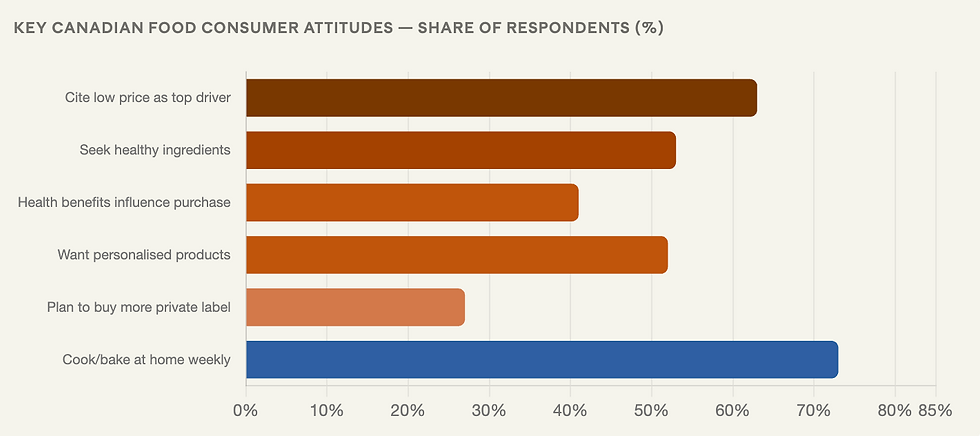
Canadian consumers do not want to choose between health and affordability. Brands that deliver both are positioned to capture the largest addressable segment in the country. Health-positioned private label bakery, accessible gluten-free options, and value-priced high-fibre products are not niche plays. They are the answer to the most common consumer dilemma in the category.
Millennials are the cohort shaping where the market moves next. Fifty percent say they will pay more to save time. Fifty-two percent want personalized products. Forty-seven percent want to engage with brands to influence what gets made. This is the consumer artisanal bakery has been capturing by default, and that large manufacturers have largely failed to address directly. Home baking is also a real factor, 73% of Canadians bake or cook at home at least once a week, sustaining baking ingredients and mixes even as broader convenience trends pull the other way.
What the Canadian Bakery Market Forecast to 2029 Actually Tells You
3.9% annual growth rate in a Can$12 billion market is Can$2 billion in new retail value over four years. The domestic story is intact. Population growth is slowing to 0.8% annually through 2029, but disposable income is growing at 3.1%, and that income is increasingly directed toward quality and health. The consumer spending Can$8 on an artisanal loaf instead of Can$4 on standard sliced bread is making a deliberate choice. Brands positioned at the quality end of that choice will capture the bulk of the value growth.

The online channel is the distribution story most brands are underweighting. E-commerce for Canadian baked goods grew at 32.1% annually from 2020 to 2025, reaching Can$520 million. That is still a small share of a Can$12 billion market but a 32% growth rate in a 3.9% overall growth environment deserves serious attention.
The tariff situation introduces real uncertainty into the export portion of this picture. The forecasts above cover domestic retail sales. Canada's total bakery sector: including exports: is a much larger and more exposed number. With the US representing 50% of total Canadian bakery sales when exports are included, any sustained reduction in cross-border shipment volume will affect manufacturing capacity utilization, employment, and the economics of domestic production in ways that eventually feed back into the retail market.
The USMCA review scheduled for July 2026 was meant to provide a framework for resolving these tensions. The Section 338 tariffs imposed on the same date as that review suggest the outcome was not a resolution. Canadian bakery manufacturers are now operating in an environment where the trade agreement they built their export infrastructure around no longer provides the protection it was designed to offer. That is a fundamental shift, and the industry is still working out what the new normal looks like.
Frequently Asked Questions: Canada Bakery Market 2026
How big is the Canadian bakery market in 2026?
Canada's retail baked goods market is estimated at approximately Can$12.7 billion in 2026, up from Can$12.2 billion in 2025. The market is forecast to reach Can$14.2 billion by 2029. Bread remains the largest category at over Can$7.7 billion, followed by pastries at approximately Can$2.3 billion. These figures cover domestic retail sales and do not include Canada's Can$7.6 billion in baked goods exports, which are facing significant disruption from US tariff escalations in 2025 and 2026.
How are US tariffs affecting Canada's bakery industry?
The impact is significant and still evolving. Starting in early 2025, a 25% US tariff on Canadian imports raised costs for American buyers of Canadian baked goods. In July 2026, the US escalated to 50% tariffs under Section 338 of the Tariff Act of 1930, removing USMCA protections that Canadian exporters had relied on since 2020. Canadian bakery exports fell as a result, with overall Canadian exports tracking 4% below pre-tariff levels by Q3 2025. Canada's counter-tariffs effective September 8, 2026 add a further complication, baking mixes and doughs imported from the US now face a 50% Canadian surtax, raising input costs for domestic manufacturers sourcing American formulations.
What is driving growth in the Canadian baked goods market despite tariff pressures?
Domestic retail demand is holding up driven by two forces. First, immigration-led demographic change is fuelling strong demand for flat breads including pita, roti, and tortilla in urban markets. Second, health and wellness trends are accelerating demand for gluten-free, keto, vegan, high-fibre, and no-sugar baked goods, a segment forecast to grow at 8.9% annually through 2029, more than double the overall market rate. These domestic drivers are largely insulated from the US trade disruption.
How fast is gluten-free bakery growing in Canada?
Gluten-free baked goods in Canada are estimated at Can$342 million in 2025 and forecast to grow at 8.8% annually through 2029, reaching approximately Can$481 million. This growth is structurally supported by rising allergy prevalence, projected at 38.5% of Canada's population by 2029, representing over 16.5 million Canadians with some form of dietary restriction.
How is Canada's bakery industry responding to US tariff pressure?
The industry response is running on two tracks. The Baking Association of Canada has publicly positioned the sector's path forward as competing on innovation rather than price, working with Global Affairs Canada to explore alternative export markets through Canada's G7 trade agreements. Simultaneously, Canadian manufacturers are actively reducing reliance on US-sourced ingredients and packaging, seeking domestic or third-country alternatives. Export diversification toward Mexico, Japan, South Korea, Taiwan, and Australia is accelerating, though building those channels from near-zero to meaningful volume takes years, not months.
Need deeper insight into Canada's food and bakery market?
Bridging Local designs custom primary research for food brands, retailers, and new market entrants navigating the Canadian consumer and trade landscape.
About This Analysis
This analysis was produced by Bridging Local (RC Research & Insights Inc.), a Vancouver-based market research and business consulting firm. We run primary research across B2B and B2C markets: surveys, competitive analysis, consumer studies, and go-to-market strategy: for brands and organizations that need real data behind their decisions, not assumptions dressed up as insight.
If you are a food brand, retailer, or entrepreneur trying to understand how Canadian consumers think, what your market actually looks like, or where your next opportunity sits, our market research services are built for exactly that. We ask the questions your customers won't answer unprompted, and we build the evidence base that turns decisions into strategies.


Comments