Detailed Analysis: Is Having an MLB Team in Vancouver a Great Idea?

This is a multi-billion-dollar question.
At first glance, Vancouver appears to be an obvious candidate for a Major League Baseball expansion. It is a globally recognized city, economically strong, culturally diverse, and already deeply embedded in professional sports culture. Interest in baseball is rising, public sentiment is favorable, and geographically, the city sits in a unique position relative to both North America and Asia.
But expansion decisions at the MLB level are not driven by surface-level indicators. They are driven by one core question:
Can this market consistently sustain a multi-hundred-million-dollar sports business over decades?
Answering that requires looking beyond enthusiasm and into behavior, economics, and structural realities.
1. The Demand Story: Strong Momentum, But Not Yet Proof of Sustainability
The most encouraging signal is the surge in interest across British Columbia.
Public sentiment has shifted meaningfully. Today, 72% of residents believe an MLB team in Vancouver would be a good or very good idea, a notable increase from previous years . At the same time, overall sports fandom in the province has grown from 68% to 79% in just five years, with baseball interest outpacing that growth.
This tells us something important:Vancouver is not a cold market for baseball. If anything, it is warming up at the right time.
However, expansion history across sports repeatedly shows that stated interest is one of the weakest predictors of long-term success.
What matters is behavioral conversion, how many of these supporters will:
Attend games regularly across an 81-game home schedule
Engage during losing seasons
Spend on merchandise, concessions, and media
Transition from casual to habitual fans
There is no evidence yet that Vancouver has crossed that threshold. What exists today is latent demand, not yet monetized demand.
2. Market Size: Viable, But Without Margin for Error
With a metro population of approximately 3.1 million, Vancouver sits in a comparable range to several existing MLB cities. Markets like Milwaukee, Kansas City, and Cincinnati operate successfully with similar or smaller populations.
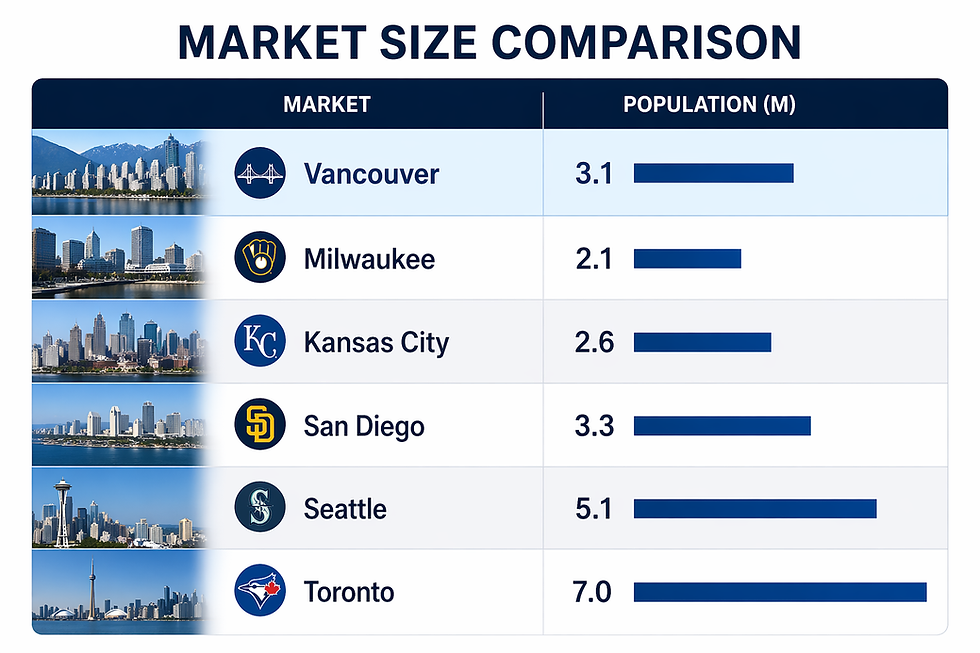
This confirms that Vancouver is not too small for Major League Baseball.
However, the more relevant comparison is not whether Vancouver can host a team, but whether it can compete economically within the league.
Compared to larger markets like Seattle (5.1M) and especially Toronto (7M), Vancouver currently lacks the population scale that typically drives:
Higher attendance ceilings
Larger corporate sponsorship pools
Stronger regional broadcasting revenue
This creates a narrower margin for error. In large markets, inefficiencies can be absorbed. In mid-sized markets like Vancouver, they are exposed quickly. We all know what happened with Montreal Expos.
3. Attendance Reality: The Core Constraint of the Entire Model
Every MLB business model is ultimately anchored in attendance. Not because ticket sales dominate revenue, but because attendance drives everything else: atmosphere, concessions, sponsorship value, and long-term fan loyalty.
To generate consistent revenue, attendance is the single most critical driver. The league’s top performers make this clear.
The Los Angeles Dodgers lead MLB with over 4 million in annual attendance, averaging roughly 49,500 fans per game. The Toronto Blue Jays, by comparison, draw about 2.8 million annually, with an average of 35,100 per game, a strong figure supported by one of the most loyal fan bases in baseball. It’s also worth noting that the Greater Toronto Area has more than double the population of Metro Vancouver, giving it a natural scale advantage.

In the above table currently Athletics is not based on Las Vegas,
Another potential benchmark for Vancouver is the Seattle Mariners, located just a few hours away. Seattle records approximately 2.5 million in annual attendance, averaging 31,300 per game, supported by a metro population of ~5.1 million.
Metro Vancouver, by contrast, has a population of ~3.1 million. If we assume a best-case scenario where Vancouver achieves per capita attendance similar to Toronto, the projected annual attendance would land around 1.2 to 1.3 million. That translates to roughly 15,000 to 15,500 fans per game.
This figure is critical.
It places Vancouver not in the middle of the league, but near the lower tier of attendance.
The implication is not just lower ticket revenue. It is a structurally smaller commercial engine:
Fewer fans in stadium → lower concessions revenue
Lower attendance optics → reduced sponsorship pricing power
Less consistent turnout → weaker home-field advantage and engagement
In practical terms, Vancouver would likely enter the league as a bottom-third attendance team, even under optimistic assumptions, at least in the early years.
Over the longer term, the more important question is whether the market can consistently scale into the 25,000 - 30,000 fans per game range? Reaching that threshold would materially change the economics of the franchise, strengthening revenue stability and positioning the team far more competitively within the league.
4. Revenue Potential: Viable but Constrained
To estimate the revenue potential for a Vancouver MLB franchise, it is important to first anchor the analysis in the financial performance of an existing Canadian benchmark, the Toronto Blue Jays.
Here is the table comparing 2025/26 revenues of all mlb teams
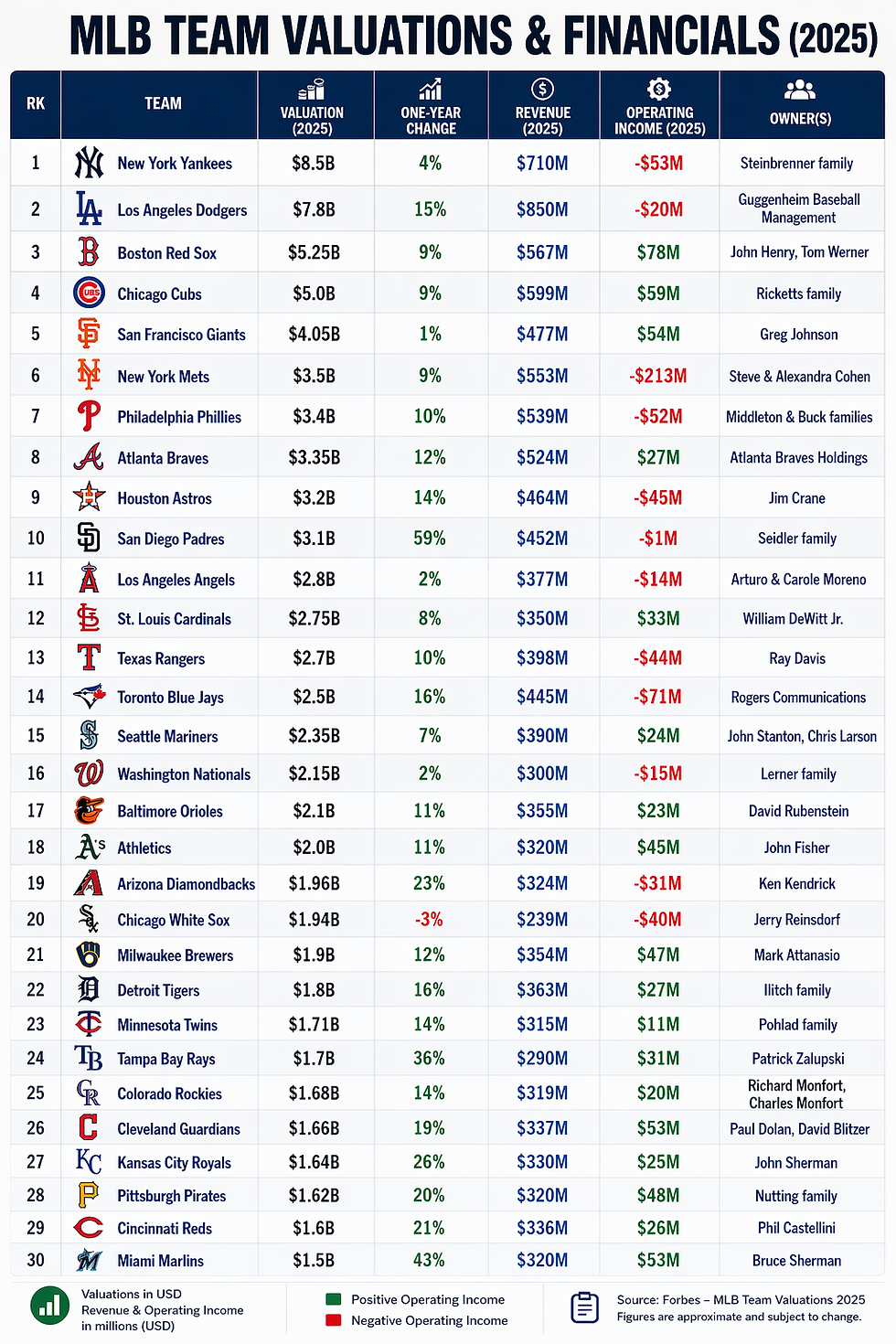
According to Forbes, the Blue Jays generated approximately US$445 million (CAD ~$606 million) in revenue in 2025. However, this figure represents a peak scenario, significantly boosted by a deep postseason run that extended to Game 7 of the World Series, effectively capturing near-maximum revenue potential for the franchise in a given year. A more normalized baseline is seen in 2024, when the team generated US$387 million (CAD ~$530 million) in revenue.
To better understand revenue at a unit level, we can isolate gate receipts. In 2024, the Blue Jays generated US$92 million in gate revenue from a total attendance of 2,681,236. This implies an average revenue per ticket of approximately US$34.31 (CAD ~$46.8).
This per-ticket figure provides a useful benchmark for modeling Vancouver’s potential gate revenue, as it reflects a real-world monetization level within the Canadian market.
Using an average ticket revenue of CAD $46.8 and a projected annual attendance in the range of 1.2 to 1.3 million, a Vancouver MLB franchise could generate approximately CAD $56 million to $61 million in gate receipts.
However, ticket sales represent only a portion of total team revenue. Across MLB, gate receipts typically account for around 30 to 31% of overall revenue, with the remainder coming from broadcasting rights, sponsorship agreements, premium seating, and in-stadium spending (concessions and merchandise).
Applying this revenue mix, Vancouver’s total annual revenue potential would be in the range of ~CAD 180 million to CAD 200 million, with a midpoint estimate of roughly CAD 195 million. This would be almost one-third of Blue Jays Revenue.
It is important to frame this as an upper-bound scenario. Actual performance would likely fall below this range in the initial years, given factors such as fan base development, team performance, and market transition from existing loyalties.
Can this revenue grow over time? The answer is yes, but it is highly dependent on attendance scaling.
If Vancouver is able to consistently draw in the range of 25,000 to 30,000 fans per game, the revenue profile changes materially. At that level of sustained attendance, the franchise could reasonably move into a CAD $350 million to $400 million annual revenue range, driven not just by higher gate receipts, but also stronger performance across sponsorships, concessions, and broadcast value.
In other words, crossing that attendance threshold would not just improve revenue incrementally, it would reposition the franchise from a lower-tier market to a more competitive mid-tier MLB business.
5. The Defining Challenge: Competing With the Blue Jays
Unlike many expansion markets, Vancouver is not starting from zero. It is starting from a market already deeply aligned with an existing team.
Based on MLB fan distribution data derived from social media following patterns, approximately 75% of baseball fans in British Columbia align with the Toronto Blue Jays. This level of support goes beyond casual interest, it reflects a deeply entrenched and highly loyal fan base, making the Blue Jays one of the most dominant regional teams in Major League Baseball.
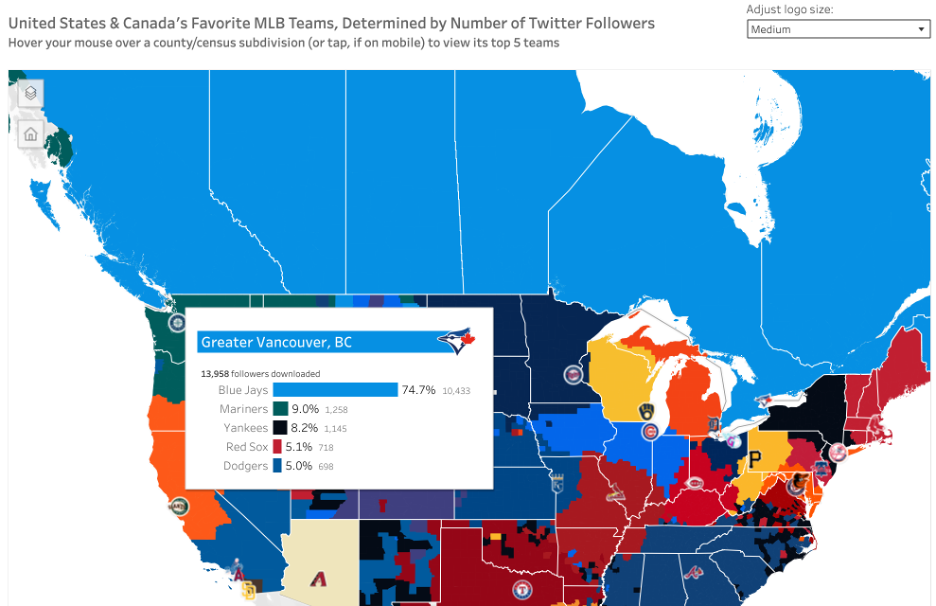
Moreover, the Seattle Mariners account for only ~9% of the MLB fan base in British Columbia, yet they still position Vancouver as part of their extended home market, highlighting how fragmented and contested the region already is.
The scale of the Toronto Blue Jays fan base further reinforces this dynamic. “Jays Nation” is estimated at 6.3 million fans nationwide, with approximately 41% located outside Ontario, a clear indication of the team’s national reach.
Engagement levels are equally strong: around 75% of Blue Jays fans follow more than half of the games each season, placing them among the most engaged fan bases in Major League Baseball.
This creates a central strategic challenge for any future Vancouver franchise:
If Vancouver gets its own MLB team, will existing Blue Jays fans in British Columbia shift their loyalty, or remain committed to an established national team?
Additional insight from the Angus Reid Institute adds an important layer to this question. Their research shows that 51% of British Columbians view the Blue Jays as “Canada’s team,” while 38% see them as a regional team. This split is telling, it underscores both the strength of the Blue Jays’ national identity and a meaningful underlying desire for a local MLB presence.
This creates a unique and difficult situation.
A Vancouver team would not simply need to attract new fans. It would need to convert existing ones.
That conversion is not immediate. It is generational.

Older fans are likely to remain loyal. Younger audiences represent the true opportunity, but building that base takes time, consistency, and often sustained on-field success.
In practical terms, this means:
Early attendance may lag expectations
Brand identity will take years to solidify
Revenue growth will be gradual, not immediate
This is perhaps the single most important strategic constraint in the entire analysis.
6. The One True Differentiator: Asia-Pacific Positioning
If there is a factor that can fundamentally change Vancouver’s trajectory, it is its geographic and cultural position relative to Asia.
Cities like Los Angeles have already demonstrated the impact of this strategy.
The success of the Los Angeles Dodgers in leveraging global stars like Shohei Ohtani shows how international talent can drive:
Sponsorship revenue
Merchandise sales
Tourism
Global brand expansion
Vancouver cannot replicate this at the same scale. But it does not need to.

Even a moderated version, targeting emerging talent from Japan and South Korea, combined with localized sponsorships, could provide:
Incremental revenue streams
Differentiation from other small-market teams
A unique brand identity within MLB
7. Grassroots Strength: A Long-Term Positive, Not a Short-Term Solution
More than 18.5 million Canadians, nearly 45% of the country’s population, tuned in to watch some or all of Game 7, underscoring the national scale of interest and engagement in baseball at its peak moments.
At the local level, Vancouver already has an established presence in professional baseball through the Vancouver Canadians. The team competes in the Northwest League as the High-A affiliate of the Toronto Blue Jays and plays at Nat Bailey Stadium, which has a seating capacity of approximately 6,500. While this reflects a strong local footprint, it also highlights the significant scale gap between minor league operations and Major League Baseball.
Beyond the professional level, the grassroots foundation for baseball in British Columbia is both broad and deeply embedded.
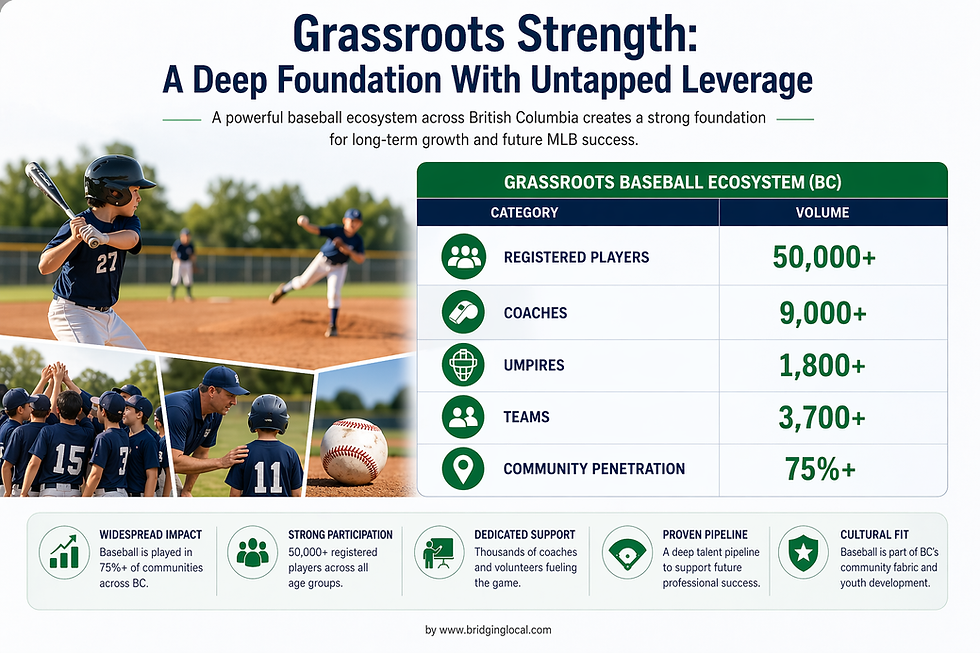
According to Baseball B.C., the provincial governing body for amateur baseball:
Over 50,000 registered players participate across the province
More than 9,000 coaches support development at various levels
There are 1,800+ certified umpires
The system includes 3,700+ organized teams
Baseball is actively played in over 75% of communities across British Columbia
This level of participation indicates that baseball is not a niche sport in the region, it is widely accessible, structurally organized, and culturally embedded.
8. Final Assessment: Viability vs. Strength
So, is an MLB team in Vancouver a great idea?
The honest answer is:
It is a viable idea, but not an easy one, and not a guaranteed success.
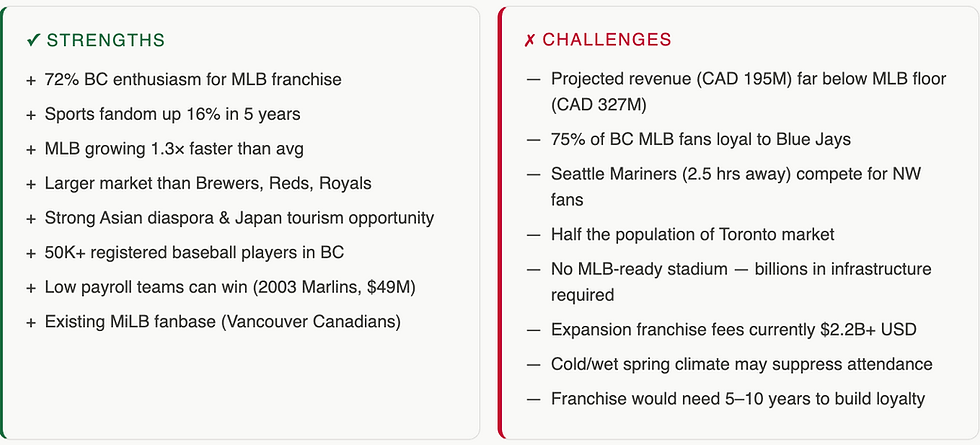
Here`s our Final Scorecard

Risk Matrix
1. High: Revenue shortfall in early years
Best-case projected revenue (CAD 195M) is roughly 60% of the lowest-earning existing MLB franchise. Owner must absorb significant losses for 5-10 years while brand equity builds.
2. High: Blue Jays fan loyalty conversion
75% of BC's MLB fans already align with Toronto. The Jays have the highest fan engagement rate in baseball. Conversion will be slow and generational.
3. High: Stadium infrastructure cost
A new MLB-standard ballpark (40,000+ capacity) would cost CAD 2-3B+. Public funding is politically contentious; private funding requires a committed billionaire owner.
4. Medium: Seattle Mariners market overlap
The Mariners claim Vancouver as part of their "natural" fan territory. Many BC fans cross the border for games. A Vancouver franchise would need to actively compete for this audience.
5. Medium: Expansion fee and MLB approval
MLB expansion fees are now estimated at USD 2.2B+ per franchise. Securing league approval, especially given geographic considerations, is not guaranteed.
6 Low: Market size vs comparable cities
At 3.1M, Vancouver's metro exceeds several successful MLB markets (Milwaukee 2.1M, Cincinnati 2.3M, Kansas City 2.6M). Market size alone is not a dealbreaker.
Overall feasibility score: 5.8/10
Possible, but not yet viable without major investment and a patient ownership group
The market enthusiasm and growth trajectory are real. But the financial gap between projected revenues and actual MLB operating costs is significant. A committed, loss-tolerant ownership group with a 10-15 year horizon, combined with a new stadium and aggressive Asian market strategy, is the path to viability.
Final Verdict
Vancouver should not be viewed as a high-revenue expansion opportunity.
It should be viewed as a strategic, long-term market play.
Success depends on accepting three realities:
The team will likely operate as a mid-to-low revenue franchise
Fan base development will take a decade or more
Differentiation, particularly through Asia-Pacific strategy is not optional
If those conditions are understood and embraced, Vancouver can support an MLB team.
If they are ignored, the same market that looks promising today could quickly become financially strained.
About Research
This brief research has been independently conducted by Bridging Local using sourced data. We also conduct surveys and qualitative analysis through user interviews. If you would like to conduct research, please reach out to us at contact@bridginglocal.com


